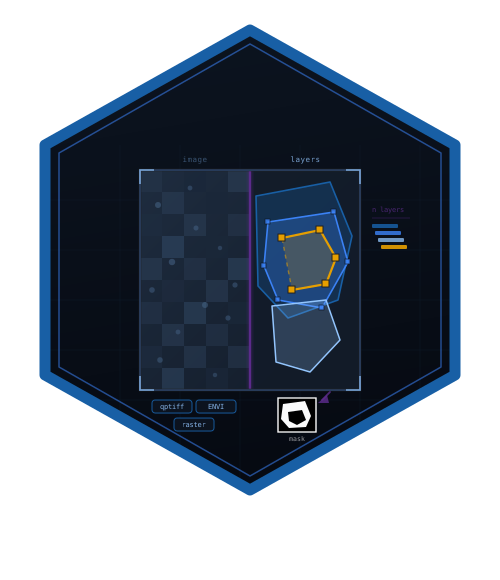
Produce a binary, labelled, or multi-class integer mask from annotations. This is the package's core output artifact.
Usage
at_mask(
  x,
  type = c("binary", "labelled", "multiclass"),
  layer = NULL,
  label = NULL,
  level = 0L,
  background = 0L,
  touches = FALSE,
  dims = NULL,
  values = NULL,
  overlap = c("last", "first", "max", "min", "error", "bitor"),
  engine = c("stars", "terra"),
  call = rlang::caller_env()
)
Arguments
- x
An annot_roi, annot_layer, or annot_project.
- type
"binary"(a logical matrix),"labelled"(one integer id per ROI), or"multiclass"(one id per label class).- layer
Optional layer name(s) to restrict to (projects only).
- label
Optional label(s) to restrict to.
- level
Integer pyramid level at which to rasterise. Default
0.- background
Integer background value. Default
0.- touches
Logical; see the coverage contract. Default
FALSE.- dims
Optional
c(width, height); taken from the image (projects) or the geometry bounding box otherwise.- values
Optional named integer vector mapping labels to explicit class codes (e.g.
c(specular = 1L, blood = 2L, shadow = 4L)), used only fortype = "multiclass". WhenNULL(default) codes follow first-seen label order. Supply power-of-two codes together withoverlap = "bitor"to build a bitfield mask.- overlap
How overlapping ROIs resolve:
"last"(later z-order wins, the default),"first","max","min","error"(abort on any overlap), or"bitor"(bitwise-OR the overlapping values, for bitfield masks; use with power-of-twovaluesandbackground = 0).- engine
"stars"(reference) or"terra"(accelerated, if installed); the two produce identical masks.- call
The calling environment, for error reporting.
Value
An annot_mask: a matrix (logical for "binary", otherwise integer)
with attributes legend (a tibble with columns value, label, layer,
roi_id, n_px, colour), level, dims, type, and created. An
all-background mask of the correct dimensions is returned when there are no
ROIs.
Details
Pixel-coverage contract. Pixel (i, j) covers the half-open square
[j-1, j) x [i-1, i) with (0, 0) at the top-left corner of the top-left
pixel; its centre is (j - 0.5, i - 0.5). With touches = FALSE (default) a
pixel is included when its centre lies inside the polygon; with
touches = TRUE a pixel is included if the polygon touches it at all. ROI
coordinates use the image convention (top-left origin, y down).
Examples
proj <- at_example_project()
m <- at_mask(proj, type = "multiclass")
table(as.integer(m))
#>
#>      0      1      2      3
#> 135640  19600  72704  34200