Course 1 — #courses
Note
Inference labs use the five-step template: Hypothesis → Visualise → Assumptions → Conduct → Conclude.
Lab 3.1.
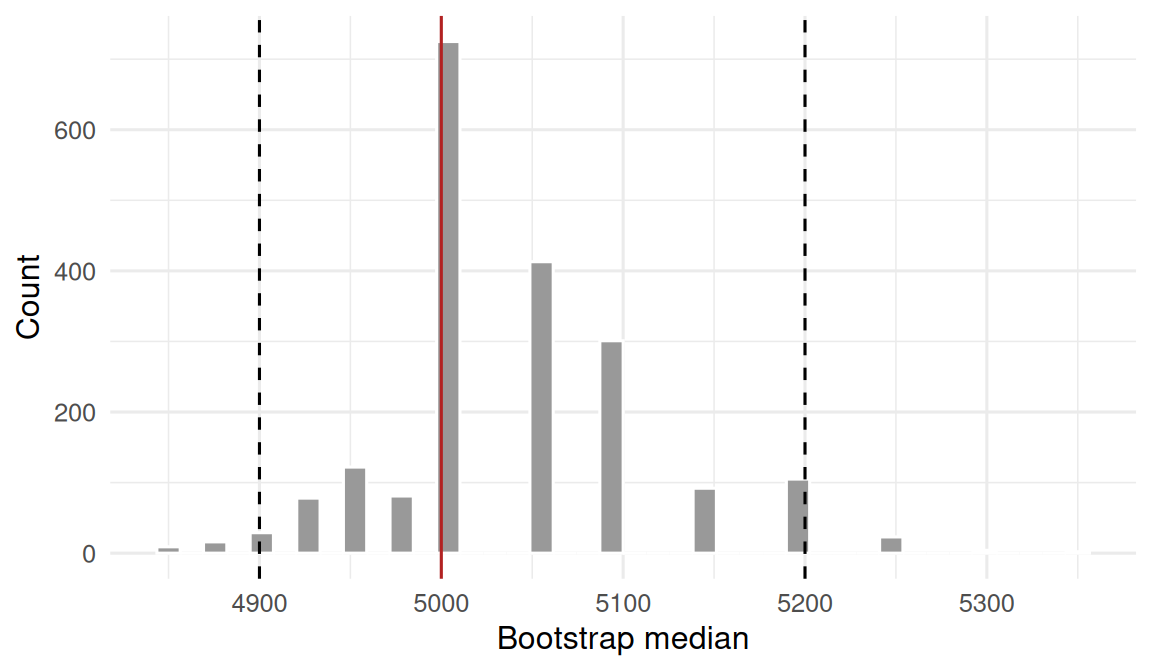
Classical inference writes down the sampling distribution of an estimator analytically, usually by invoking the central limit theorem and assuming a parametric family for the data. Resampling methods replace this step with computation. A bootstrap confidence interval for a statistic is built by drawing repeated samples with replacement from the observed data and recomputing the statistic; the empirical distribution of the recomputed values is treated as a proxy for the sampling distribution.
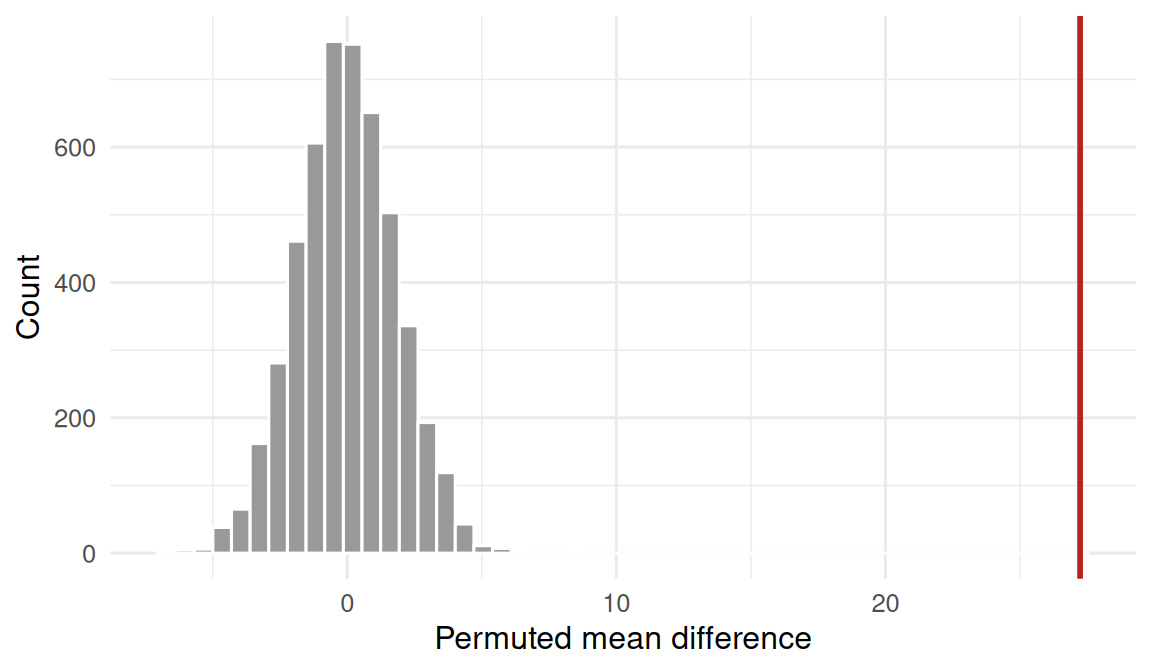
A permutation test answers a different question. It randomly reassigns the group labels on the observed data and recomputes the test statistic; the empirical distribution of the recomputed values is the sampling distribution under the null of exchangeability — that is, under a null in which the group labels are interchangeable. It gives a p-value without any assumption about the shape of the underlying distributions.
The two techniques look similar — both involve a loop and a replicate() — but they are different tools. Bootstrap estimates uncertainty under the observed data-generating process; permutation tests a sharp null of no association.
Two hypotheses in this lab:
Use palmerpenguins.
Bootstrap: the observed sample is representative of the population we wish to generalise to. Resampling with replacement preserves the univariate structure but assumes exchangeability of observations.
Permutation: under H0, group labels can be reshuffled without changing the joint distribution. The test does not assume normality or equal variances.
gen <- dat |> filter(species == "Gentoo") |> pull(body_mass_g)
B <- 2000
boot_meds <- replicate(B, median(sample(gen, replace = TRUE)))
ci_med <- quantile(boot_meds, c(0.025, 0.975))
obs_med <- median(gen)
tibble(statistic = "median body mass",
observed = obs_med,
ci_low = ci_med[1],
ci_high = ci_med[2])# A tibble: 1 × 4
statistic observed ci_low ci_high
<chr> <int> <dbl> <dbl>
1 median body mass 5000 4900 5200
[1] 0
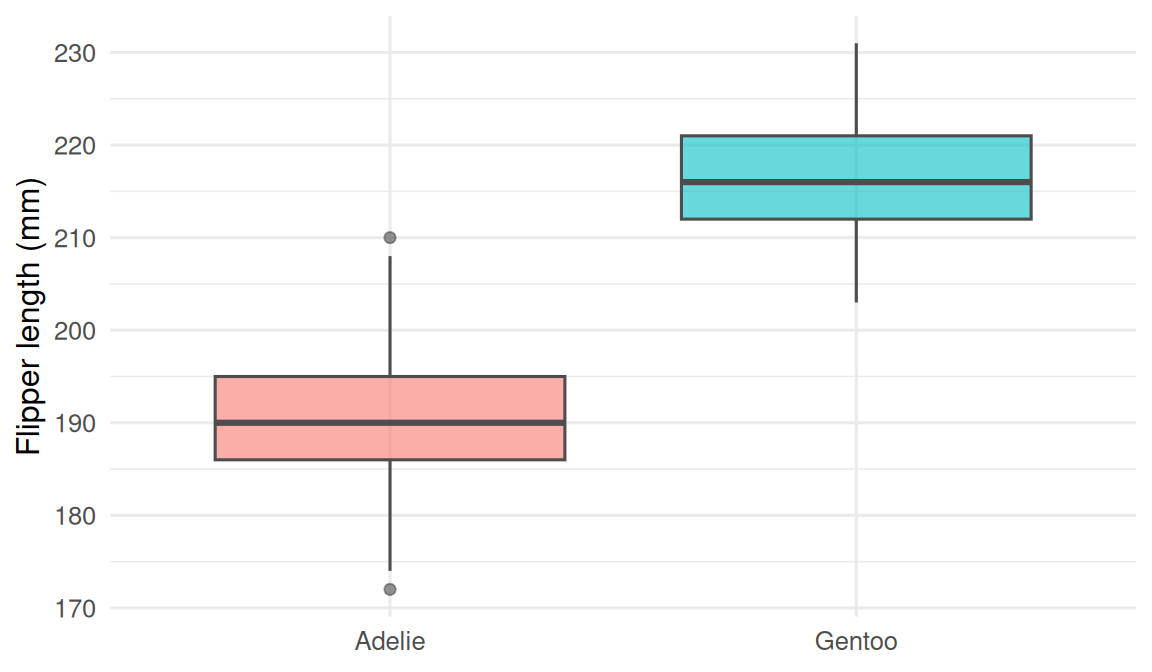
Based on B = 2000 bootstrap resamples, the median body mass in Gentoo penguins (n = 123) was 5000 g (95% percentile bootstrap CI 4900 to 5200 g). Flipper length was much longer in Gentoo than Adelie (mean difference 27.2 mm); a permutation test over 5000 reshuffles produced p = 0, providing strong evidence against exchangeability.
Bootstrap and permutation give you parametric-free tools for estimation and testing respectively. Neither rescues you from a biased sample; both depend on the data at hand being representative.
R version 4.4.1 (2024-06-14)
Platform: x86_64-pc-linux-gnu
Running under: Ubuntu 24.04.4 LTS
Matrix products: default
BLAS: /usr/lib/x86_64-linux-gnu/openblas-pthread/libblas.so.3
LAPACK: /usr/lib/x86_64-linux-gnu/openblas-pthread/libopenblasp-r0.3.26.so; LAPACK version 3.12.0
locale:
[1] LC_CTYPE=C.UTF-8 LC_NUMERIC=C LC_TIME=C.UTF-8
[4] LC_COLLATE=C.UTF-8 LC_MONETARY=C.UTF-8 LC_MESSAGES=C.UTF-8
[7] LC_PAPER=C.UTF-8 LC_NAME=C LC_ADDRESS=C
[10] LC_TELEPHONE=C LC_MEASUREMENT=C.UTF-8 LC_IDENTIFICATION=C
time zone: UTC
tzcode source: system (glibc)
attached base packages:
[1] stats graphics grDevices utils datasets methods base
other attached packages:
[1] palmerpenguins_0.1.1 lubridate_1.9.5 forcats_1.0.1
[4] stringr_1.6.0 dplyr_1.2.1 purrr_1.2.2
[7] readr_2.2.0 tidyr_1.3.2 tibble_3.3.1
[10] ggplot2_4.0.3 tidyverse_2.0.0
loaded via a namespace (and not attached):
[1] gtable_0.3.6 jsonlite_2.0.0 compiler_4.4.1 tidyselect_1.2.1
[5] scales_1.4.0 yaml_2.3.12 fastmap_1.2.0 R6_2.6.1
[9] labeling_0.4.3 generics_0.1.4 knitr_1.51 htmlwidgets_1.6.4
[13] pillar_1.11.1 RColorBrewer_1.1-3 tzdb_0.5.0 rlang_1.2.0
[17] utf8_1.2.6 stringi_1.8.7 xfun_0.57 S7_0.2.2
[21] otel_0.2.0 timechange_0.4.0 cli_3.6.6 withr_3.0.2
[25] magrittr_2.0.5 digest_0.6.39 grid_4.4.1 hms_1.1.4
[29] lifecycle_1.0.5 vctrs_0.7.3 evaluate_1.0.5 glue_1.8.1
[33] farver_2.1.2 rmarkdown_2.31 tools_4.4.1 pkgconfig_2.0.3
[37] htmltools_0.5.9