library(tidyverse)
set.seed(42)
theme_set(theme_minimal(base_size = 12))Week 4, Session 2 — Two proportions, chi-square, risk and odds
Course 1 — #courses
Note
Inference labs use the five-step template: Hypothesis → Visualise → Assumptions → Conduct → Conclude.
Learning objectives
- Compare two proportions with
prop.test()andfisher.test()and say when each is preferred. - Compute risk ratio, odds ratio, and risk difference with confidence intervals.
- Run a chi-square goodness-of-fit test against a named distribution.
Prerequisites
Labs 2.4, 3.4.
Background
Two-proportion tests ask whether the rate of an event differs between two groups. In a 2x2 table, two exposure groups (say, treatment and control) each produce a fraction of events. The chi-square test compares the observed counts to those expected under independence; Fisher’s exact test computes the probability of a table as extreme or more extreme directly from the hypergeometric distribution and is preferred when expected cell counts are small.
The effect can be expressed in several ways. The risk difference is the difference of the two proportions. The risk ratio is their ratio — the event rate in the treated group, relative to control. The odds ratio is the ratio of the odds. In a case-control study the risk ratio is not directly estimable; the odds ratio is. In a cohort study both are estimable and the risk ratio is usually more intuitive.
Goodness-of-fit tests compare a vector of observed counts to a vector of expected proportions under a named distribution — whether a die is fair, whether a set of genotype frequencies matches Hardy-Weinberg, whether arrivals over an hour are Poisson. The test statistic is the same chi-square; the interpretation is “is the distribution consistent with a named model?”
Setup
1. Hypothesis
Two-by-two: treatment vs control, outcome event vs none.
- H0: event rate is independent of treatment.
- H1: rates differ.
- α = 0.05.
2. Visualise
Simulate: 200 per arm, event rate 0.25 in control, 0.15 in treatment.
n_per <- 200
sim <- tibble(
  arm = rep(c("control", "treatment"), each = n_per),
  event = c(rbinom(n_per, 1, 0.25),
            rbinom(n_per, 1, 0.15))
)
tab <- table(arm = sim$arm, event = sim$event)
tab
event
arm 0 1
control 148 52
treatment 167 33as_tibble(tab) |>
mutate(arm = factor(arm, levels = c("control", "treatment")),
event = recode(event, `0` = "no event", `1` = "event")) |>
ggplot(aes(arm, n, fill = event)) +
geom_col(position = "fill", alpha = 0.7) +
labs(x = NULL, y = "Proportion", fill = NULL)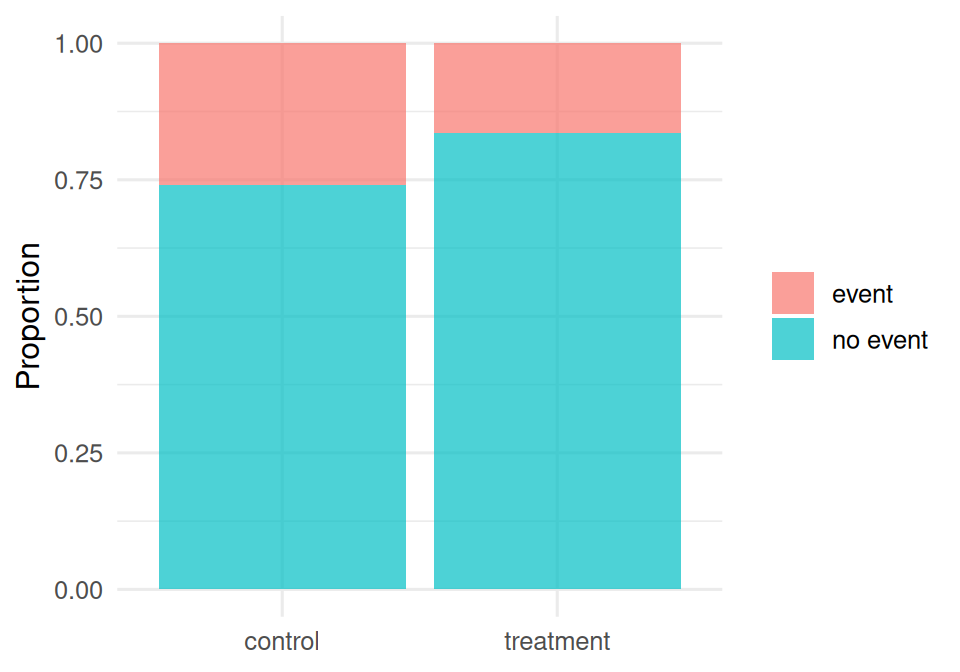
3. Assumptions
Chi-square requires expected cell counts ≥ 5. Fisher has no such constraint and is exact at any size. Random assignment or representative sampling is assumed. Independence of observations is essential.
chisq.test(tab)$expected event
arm 0 1
control 157.5 42.5
treatment 157.5 42.5All expected counts large; chi-square is appropriate.
4. Conduct
ct <- chisq.test(tab, correct = FALSE)
ft <- fisher.test(tab)
pt <- prop.test(x = tab[, "1"], n = rowSums(tab), correct = FALSE)
list(chisq = ct, fisher = ft, prop = pt)
$chisq
Pearson's Chi-squared test
data: tab
X-squared = 5.3931, df = 1, p-value = 0.02022
$fisher
Fisher's Exact Test for Count Data
data: tab
p-value = 0.02743
alternative hypothesis: true odds ratio is not equal to 1
95 percent confidence interval:
0.3331919 0.9418077
sample estimates:
odds ratio
0.5632336
$prop
2-sample test for equality of proportions without continuity correction
data: tab[, "1"] out of rowSums(tab)
X-squared = 5.3931, df = 1, p-value = 0.02022
alternative hypothesis: two.sided
95 percent confidence interval:
0.01536478 0.17463522
sample estimates:
prop 1 prop 2
0.260 0.165 Effect sizes: RD, RR, OR
p_ctrl <- tab["control",   "1"] / sum(tab["control", ])
p_trt  <- tab["treatment", "1"] / sum(tab["treatment", ])

rd <- p_trt - p_ctrl

rr <- p_trt / p_ctrl
# Log-based Wald CI for RR
se_log_rr <- sqrt(
  (1 - p_trt)  / (p_trt  * sum(tab["treatment", ])) +
  (1 - p_ctrl) / (p_ctrl * sum(tab["control",   ]))
)
ci_rr <- exp(log(rr) + c(-1, 1) * qnorm(0.975) * se_log_rr)

or <- (tab["treatment", "1"] * tab["control", "0"]) /
      (tab["treatment", "0"] * tab["control", "1"])
se_log_or <- sqrt(sum(1 / tab))
ci_or <- exp(log(or) + c(-1, 1) * qnorm(0.975) * se_log_or)

tibble(effect = c("RD", "RR", "OR"),
       est = c(rd, rr, or),
       ci_low = c(pt$conf.int[1], ci_rr[1], ci_or[1]),
       ci_high = c(pt$conf.int[2], ci_rr[2], ci_or[2]))
# A tibble: 3 × 4
effect est ci_low ci_high
<chr> <dbl> <dbl> <dbl>
1 RD -0.095 0.0154 0.175
2 RR 0.635 0.430 0.937
3 OR 0.562 0.345 0.917Goodness-of-fit example
Test whether 600 simulated genotype counts match Hardy-Weinberg proportions at allele frequency 0.3.
obs <- c(AA = 260, Aa = 290, aa = 50)
pAA <- 0.7^2; paa <- 0.3^2; pAa <- 2 * 0.7 * 0.3
exp_probs <- c(AA = pAA, Aa = pAa, aa = paa)
gof <- chisq.test(obs, p = exp_probs)
gof
    Chi-squared test for given probabilities

data:  obs
X-squared = 9.9584, df = 2, p-value = 0.006879
5. Concluding statement
Event rates were 0.26 in control and 0.165 in treatment (RD -0.095; RR 0.63, 95% CI 0.43 to 0.94; OR 0.56, 95% CI 0.34 to 0.92). Chi-square test χ² = 5.39, df = 1, p = 0.02. The Hardy-Weinberg goodness-of-fit test on simulated genotypes gave χ² = 9.96 (df = 2, p = 0.0069).
Report RR or OR alongside the p-value. In a cohort design prefer RR, which is the quantity clinicians translate directly to practice.
Remind students that OR and RR diverge when the outcome is common. This is the single most-quoted basic epidemiology point in Course 2.
Common pitfalls
- Reporting an OR when a RR is meaningful and more interpretable.
- Using the continuity correction (the default in
prop.testandchisq.test) by habit; it is conservative. - Running a chi-square when expected counts are small; use Fisher.
- Treating independent observations as if repeated measures weren’t.
Further reading
- Altman DG. Practical Statistics for Medical Research, chapter 10–11.
- Agresti A. Categorical Data Analysis.
Session info
sessionInfo()R version 4.5.2 (2025-10-31 ucrt)
Platform: x86_64-w64-mingw32/x64
Running under: Windows 11 x64 (build 26200)
Matrix products: default
LAPACK version 3.12.1
locale:
[1] LC_COLLATE=English_Germany.utf8 LC_CTYPE=English_Germany.utf8
[3] LC_MONETARY=English_Germany.utf8 LC_NUMERIC=C
[5] LC_TIME=English_Germany.utf8
time zone: Europe/Berlin
tzcode source: internal
attached base packages:
[1] stats graphics grDevices utils datasets methods base
other attached packages:
[1] lubridate_1.9.5 forcats_1.0.1 stringr_1.6.0 dplyr_1.2.1
[5] purrr_1.2.2 readr_2.2.0 tidyr_1.3.2 tibble_3.3.1
[9] ggplot2_4.0.3 tidyverse_2.0.0
loaded via a namespace (and not attached):
[1] gtable_0.3.6 jsonlite_2.0.0 compiler_4.5.2 tidyselect_1.2.1
[5] scales_1.4.0 yaml_2.3.12 fastmap_1.2.0 R6_2.6.1
[9] labeling_0.4.3 generics_0.1.4 knitr_1.51 htmlwidgets_1.6.4
[13] pillar_1.11.1 RColorBrewer_1.1-3 tzdb_0.5.0 rlang_1.2.0
[17] utf8_1.2.6 stringi_1.8.7 xfun_0.57 S7_0.2.2
[21] otel_0.2.0 timechange_0.4.0 cli_3.6.6 withr_3.0.2
[25] magrittr_2.0.4 digest_0.6.39 grid_4.5.2 hms_1.1.4
[29] lifecycle_1.0.5 vctrs_0.7.3 evaluate_1.0.5 glue_1.8.1
[33] farver_2.1.2 rmarkdown_2.31 tools_4.5.2 pkgconfig_2.0.3
[37] htmltools_0.5.9