Week 2, Session 3 — RCBD and repeated measures → mixed models

Course 2 — #courses

R. Heller

Note

Inference labs use the five-step template: Hypothesis → Visualise → Assumptions → Conduct → Conclude.

Learning objectives

  • Fit a randomised complete block design (RCBD) with aov() and read the block term.
  • Move from repeated-measures ANOVA to a mixed model with lme4::lmer().
  • Interpret random intercepts as between-subject variance and residuals as within-subject variance.

Prerequisites

Sessions 1–2 of this week.

Background

Blocks and repeated measures share a single idea: some units are more similar to themselves than to the rest of the data. In an RCBD, the block absorbs nuisance variation (plots in a field, litter in an experiment) so the treatment effect can be estimated against a smaller error. In repeated-measures designs, subjects serve as their own blocks because each is measured more than once. In both cases, ignoring the grouping inflates the standard error of the treatment effect and sometimes the Type I error of the test.

Classical RCBD ANOVA treats the block as a fixed factor with a line in the ANOVA table. Modern practice is usually to treat the block (or subject) as a random effect in a mixed model, which separates between-block and within-block variance explicitly and produces standard errors that account for the correlation.

The sleep dataset from base R is a ready-made within-subject design: each of ten subjects received two drugs and reported extra hours of sleep. A paired t-test answers the main question; a mixed model with subject as a random intercept is the same thing with more machinery and more honest diagnostics.

Setup

library(tidyverse)
library(broom)
library(broom.mixed)
library(lme4)
set.seed(42)
theme_set(theme_minimal(base_size = 12))

1. Hypothesis

Using the sleep dataset, does drug group affect extra hours of sleep after accounting for the within-subject pairing?

2. Visualise

ggplot(sleep, aes(group, extra, group = ID)) +
  geom_line(colour = "grey70") +
  geom_point(aes(colour = group), size = 3) +
  labs(x = "Drug", y = "Extra sleep (hours)", colour = "Drug")

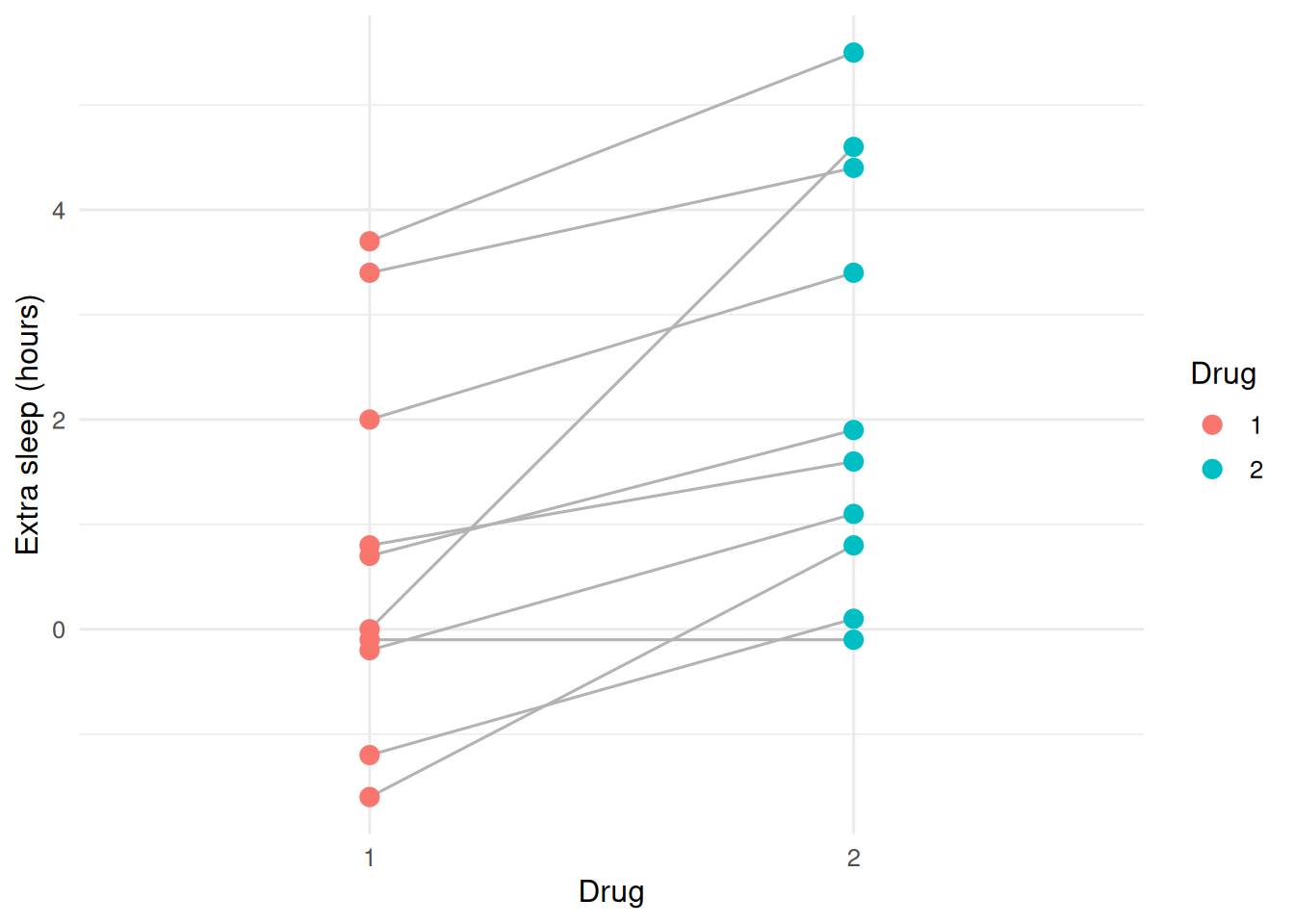
Lines track each subject across the two drugs. Most rise from left to right, suggesting drug 2 adds more sleep than drug 1.

3. Assumptions

fit_rcbd <- aov(extra ~ group + Error(ID), data = sleep)
summary(fit_rcbd)

Error: ID
          Df Sum Sq Mean Sq F value Pr(>F)
Residuals  9  58.08   6.453               

Error: Within
          Df Sum Sq Mean Sq F value  Pr(>F)   
group      1 12.482  12.482    16.5 0.00283 **
Residuals  9  6.808   0.756                   
---
Signif. codes:  0 '***' 0.001 '**' 0.01 '*' 0.05 '.' 0.1 ' ' 1

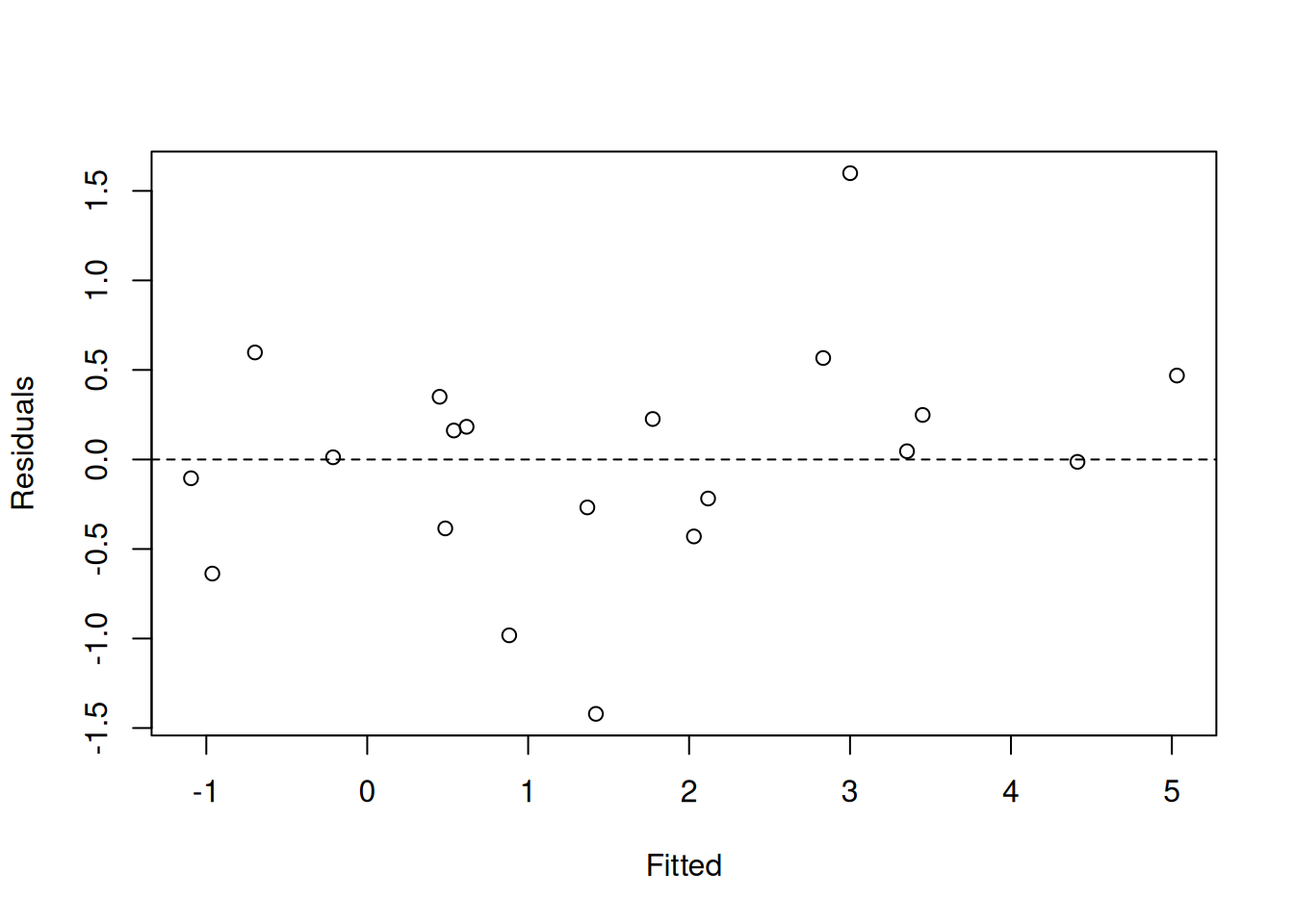
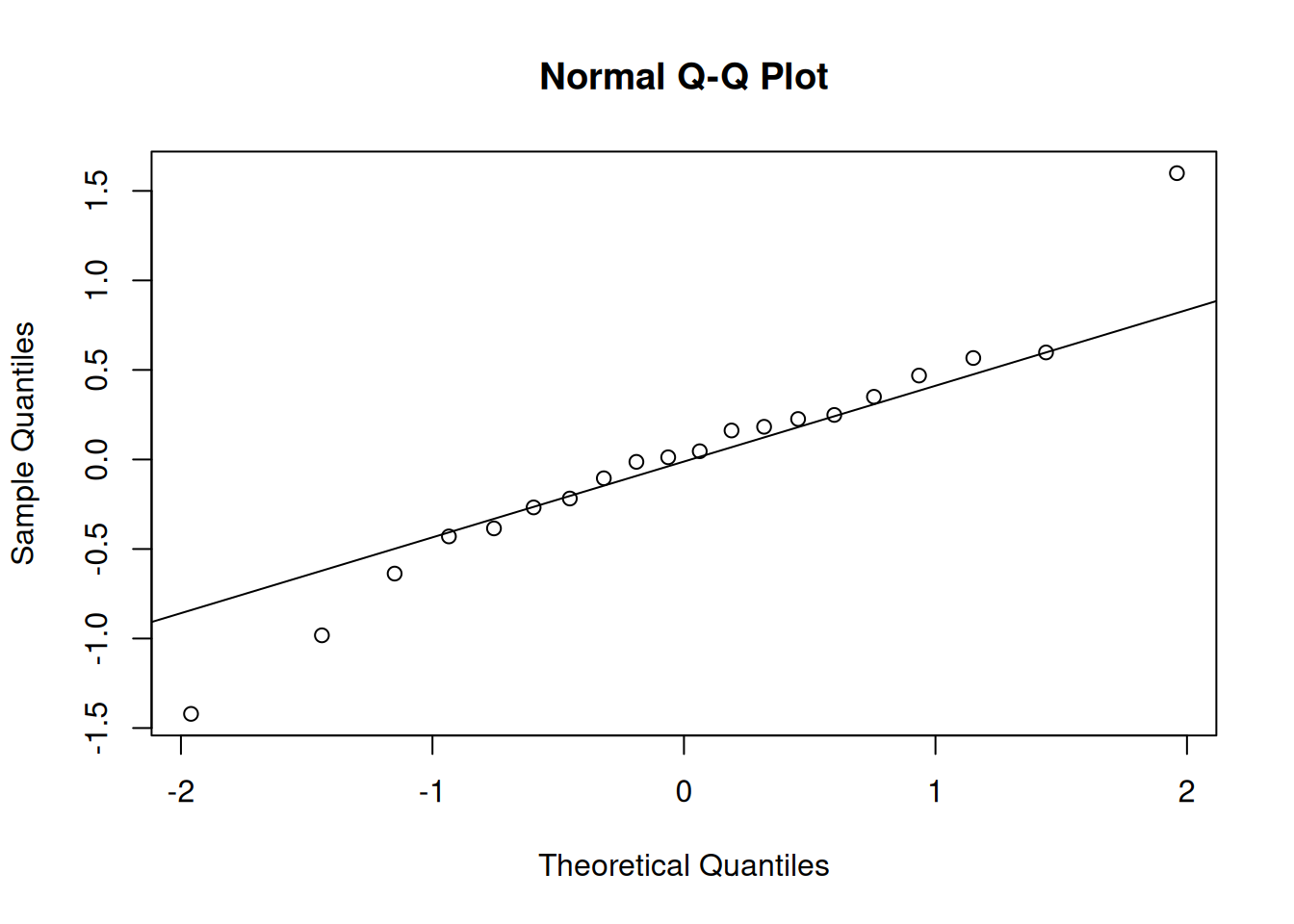
Residual diagnostics for the mixed version:
fit_lmm <- lmer(extra ~ group + (1 | ID), data = sleep)
qqnorm(resid(fit_lmm)); qqline(resid(fit_lmm))

plot(fitted(fit_lmm), resid(fit_lmm),
     xlab = "Fitted", ylab = "Residuals"); abline(h = 0, lty = 2)

4. Conduct

summary(fit_lmm)
Linear mixed model fit by REML ['lmerMod']
Formula: extra ~ group + (1 | ID)
   Data: sleep

REML criterion at convergence: 70

Scaled residuals: 
     Min       1Q   Median       3Q      Max 
-1.63372 -0.34157  0.03346  0.31511  1.83859 

Random effects:
 Groups   Name        Variance Std.Dev.
 ID       (Intercept) 2.8483   1.6877  
 Residual             0.7564   0.8697  
Number of obs: 20, groups:  ID, 10

Fixed effects:
            Estimate Std. Error t value
(Intercept)   0.7500     0.6004   1.249
group2        1.5800     0.3890   4.062

Correlation of Fixed Effects:
       (Intr)
group2 -0.324
tidy(fit_lmm, conf.int = TRUE, effects = "fixed")
# A tibble: 2 × 7
  effect term        estimate std.error statistic conf.low conf.high
  <chr>  <chr>          <dbl>     <dbl>     <dbl>    <dbl>     <dbl>
1 fixed  (Intercept)    0.750     0.600      1.25   -0.427      1.93
2 fixed  group2         1.58      0.389      4.06    0.818      2.34

The random intercept variance captures between-subject differences in baseline sleep; the residual variance captures within-subject noise.

5. Concluding statement

In ten subjects each given both drugs, drug 2 was associated with 1.58 additional hours of extra sleep relative to drug 1 (95% CI from the mixed model: 0.82 to 2.34). The model included a random intercept for subject to account for the pairing.

Common pitfalls

  • Ignoring the pairing and fitting a two-sample t-test.
  • Fitting a random slope that the data cannot identify (tiny cluster sizes).
  • Reporting only fixed-effect estimates and omitting the variance components.

Further reading

  • Pinheiro JC, Bates DM. Mixed-Effects Models in S and S-PLUS.
  • Bates D et al. (2015), Fitting linear mixed-effects models using lme4.
  • Zuur AF et al. Mixed Effects Models and Extensions in Ecology.

Session info

sessionInfo()
R version 4.4.1 (2024-06-14)
Platform: x86_64-pc-linux-gnu
Running under: Ubuntu 24.04.4 LTS

Matrix products: default
BLAS:   /usr/lib/x86_64-linux-gnu/openblas-pthread/libblas.so.3 
LAPACK: /usr/lib/x86_64-linux-gnu/openblas-pthread/libopenblasp-r0.3.26.so;  LAPACK version 3.12.0

locale:
 [1] LC_CTYPE=C.UTF-8       LC_NUMERIC=C           LC_TIME=C.UTF-8       
 [4] LC_COLLATE=C.UTF-8     LC_MONETARY=C.UTF-8    LC_MESSAGES=C.UTF-8   
 [7] LC_PAPER=C.UTF-8       LC_NAME=C              LC_ADDRESS=C          
[10] LC_TELEPHONE=C         LC_MEASUREMENT=C.UTF-8 LC_IDENTIFICATION=C   

time zone: UTC
tzcode source: system (glibc)

attached base packages:
[1] stats     graphics  grDevices utils     datasets  methods   base     

other attached packages:
 [1] lme4_2.0-1          Matrix_1.7-0        broom.mixed_0.2.9.7
 [4] broom_1.0.12        lubridate_1.9.5     forcats_1.0.1      
 [7] stringr_1.6.0       dplyr_1.2.1         purrr_1.2.2        
[10] readr_2.2.0         tidyr_1.3.2         tibble_3.3.1       
[13] ggplot2_4.0.3       tidyverse_2.0.0    

loaded via a namespace (and not attached):
 [1] gtable_0.3.6       xfun_0.57          htmlwidgets_1.6.4  lattice_0.22-6    
 [5] tzdb_0.5.0         vctrs_0.7.3        tools_4.4.1        Rdpack_2.6.6      
 [9] generics_0.1.4     parallel_4.4.1     pkgconfig_2.0.3    RColorBrewer_1.1-3
[13] S7_0.2.2           lifecycle_1.0.5    compiler_4.4.1     farver_2.1.2      
[17] codetools_0.2-20   htmltools_0.5.9    yaml_2.3.12        pillar_1.11.1     
[21] furrr_0.4.0        nloptr_2.2.1       MASS_7.3-60.2      reformulas_0.4.4  
[25] boot_1.3-30        nlme_3.1-164       parallelly_1.47.0  tidyselect_1.2.1  
[29] digest_0.6.39      stringi_1.8.7      future_1.70.0      listenv_0.10.1    
[33] labeling_0.4.3     splines_4.4.1      fastmap_1.2.0      grid_4.4.1        
[37] cli_3.6.6          magrittr_2.0.5     utf8_1.2.6         withr_3.0.2       
[41] scales_1.4.0       backports_1.5.1    timechange_0.4.0   rmarkdown_2.31    
[45] globals_0.19.1     otel_0.2.0         hms_1.1.4          evaluate_1.0.5    
[49] knitr_1.51         rbibutils_2.4.1    rlang_1.2.0        Rcpp_1.1.1-1.1    
[53] glue_1.8.1         minqa_1.2.8        jsonlite_2.0.0     R6_2.6.1