Week 1, Session 4 — Clustering: k-means, hierarchical, model-based

Course 4 — #courses

R. Heller

Note

Workflow labs use the variant template: Goal → Approach → Execution → Check → Report.

Learning objectives

  • Fit k-means and hierarchical clusterings, and choose k by elbow and silhouette.
  • Fit a model-based clustering with mclust and select the number of components by BIC.
  • Explain why “number of clusters” is often not the right question.

Prerequisites

PCA from Session 3; distance and linkage from Course 1.

Background

Clustering is a search for structure in unlabelled data, and unlike classification it has no gold standard. Any algorithm will return a partition if asked to, and the partitions it returns depend on assumptions about what a cluster is. K-means assumes roughly spherical, equal-variance clusters and needs k in advance. Hierarchical clustering produces a nested sequence of partitions at every k, which you cut at a level you choose. Model-based clustering fits a Gaussian mixture and selects k by information criterion, which at least makes the assumption explicit.

In biomedicine, the honest version of “how many clusters?” is usually “is there more than one?” A good clustering lab focuses on stability and interpretability of the partition rather than on the number returned.

When you report a clustering, report the number of clusters, the criterion used to select it, a visualisation in a 2-D projection (PCA or UMAP), and the size and key features of each cluster. Do not report p-values for cluster labels against the data that produced the labels; that circularity is a classic error.

Setup

library(tidyverse)
library(mclust)
library(cluster)
set.seed(42)
theme_set(theme_minimal(base_size = 12))

1. Goal

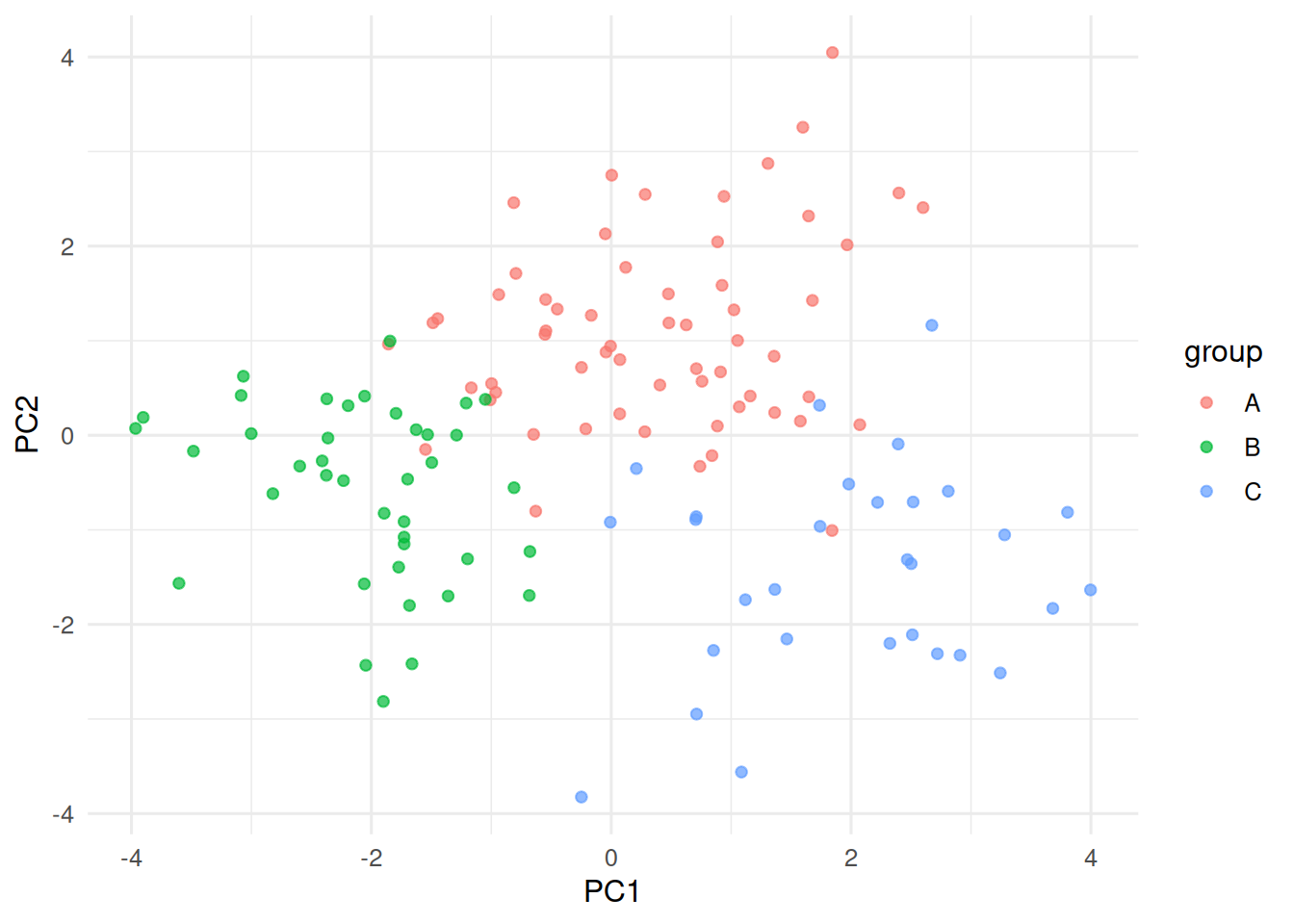
Cluster a simulated dataset with three known groups using three algorithms, and see which recovers the structure.

2. Approach

Three Gaussian blobs in 5 dimensions with different sizes.

make_blob <- function(n, mu, sd = 1) matrix(rnorm(n * 5, 0, sd), n, 5) +
  rep(mu, each = n)
X <- rbind(
  make_blob(60, c(0, 0, 0, 0, 0)),
  make_blob(40, c(3, 0, 0, 0, 0)),
  make_blob(30, c(0, 3, 0, 0, 0))
)
true_lbl <- rep(c("A", "B", "C"), c(60, 40, 30))

pc <- prcomp(X)$x[, 1:2]
tibble(PC1 = pc[, 1], PC2 = pc[, 2], group = true_lbl) |>
  ggplot(aes(PC1, PC2, colour = group)) + geom_point(alpha = 0.7)
3. Execution

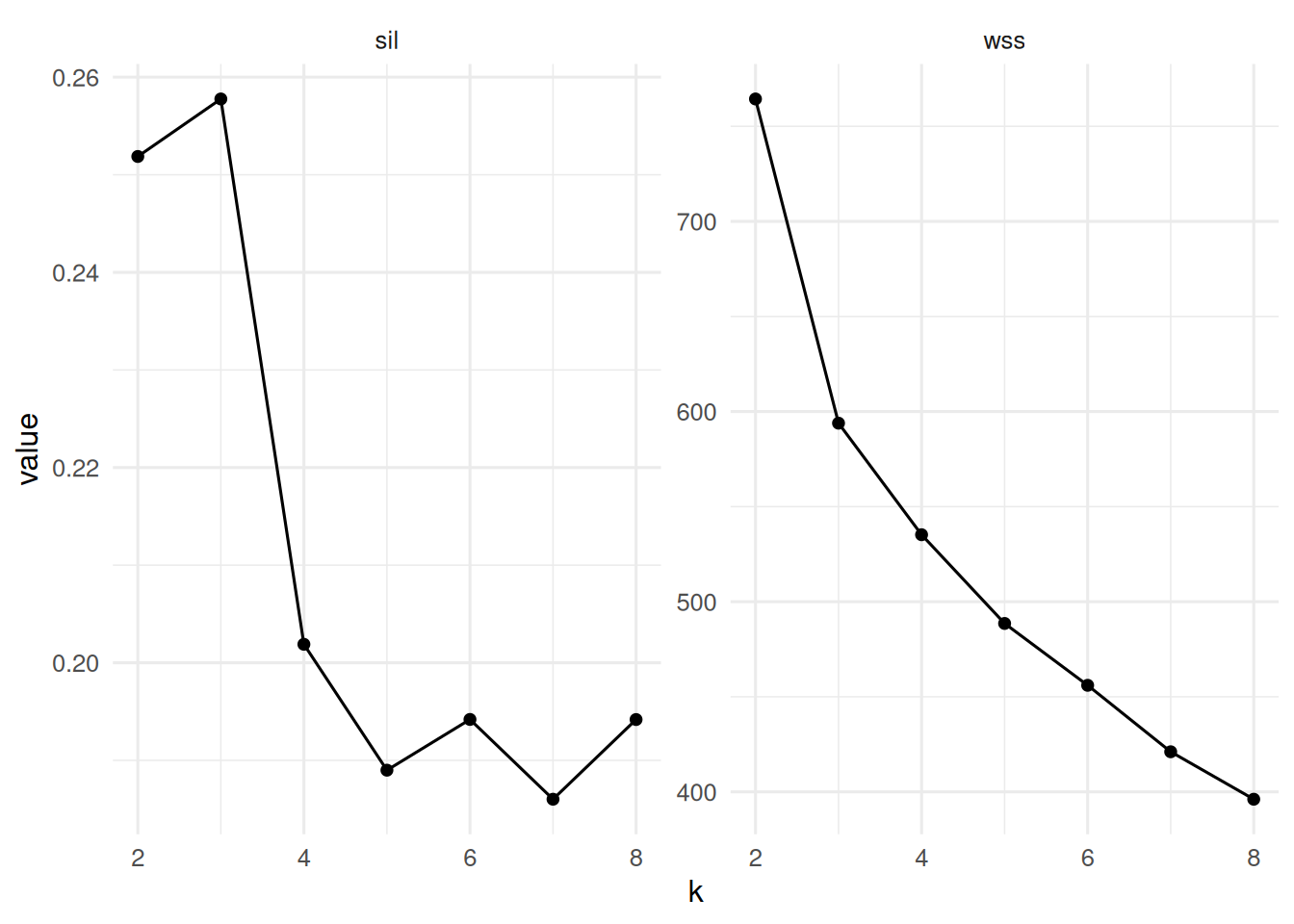
K-means with k sweep; silhouette.

wss <- sapply(2:8, function(k) kmeans(X, centers = k, nstart = 10)$tot.withinss)
sil <- sapply(2:8, function(k) {
  km <- kmeans(X, centers = k, nstart = 10)
  mean(silhouette(km$cluster, dist(X))[, 3])
})
tibble(k = 2:8, wss = wss, sil = sil) |>
  pivot_longer(-k) |>
  ggplot(aes(k, value)) + geom_line() + geom_point() +
  facet_wrap(~ name, scales = "free_y")
Hierarchical with Ward linkage.
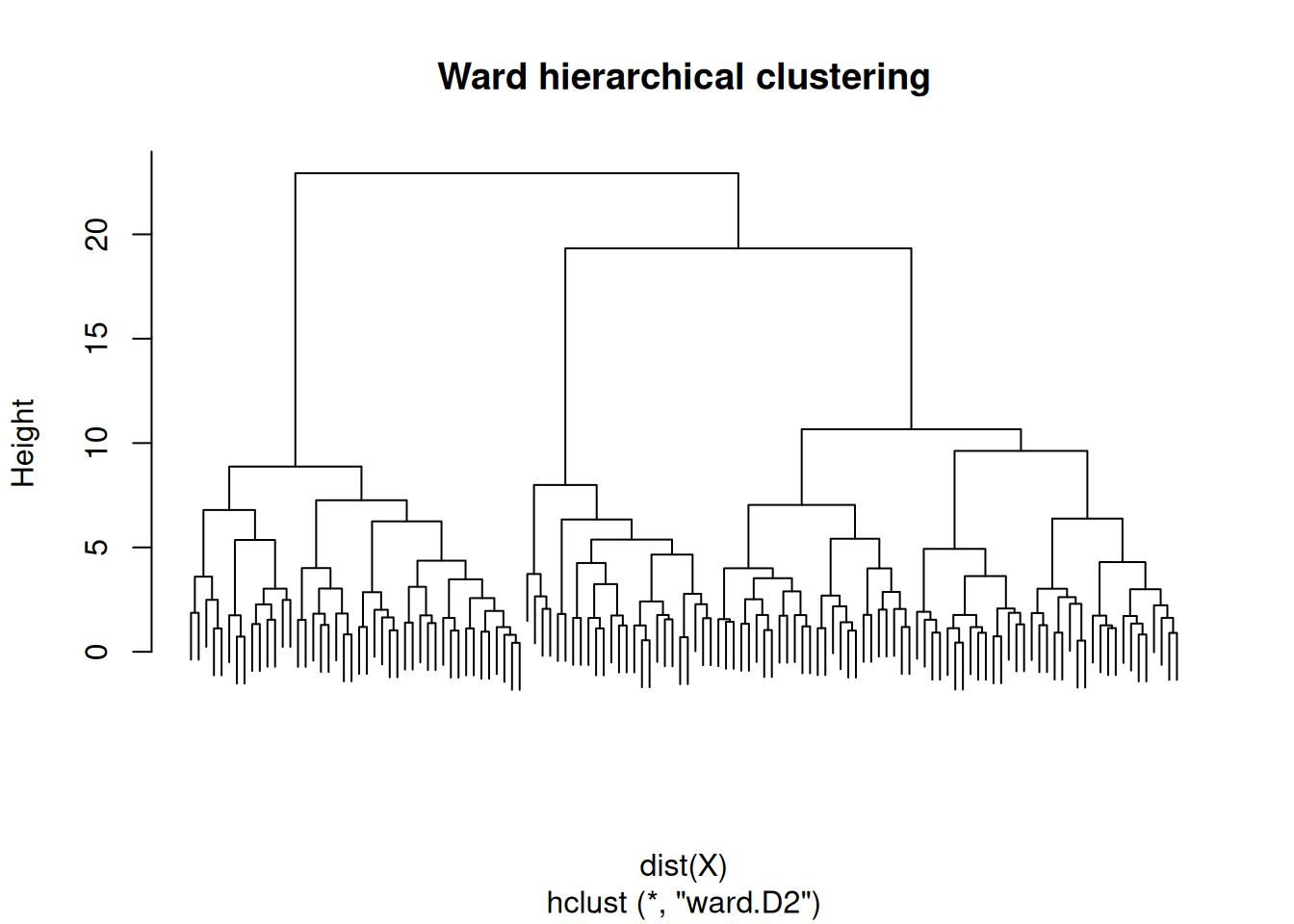
hc <- hclust(dist(X), method = "ward.D2")
plot(hc, labels = FALSE, main = "Ward hierarchical clustering")

4. Check

Model-based clustering by BIC.

mc <- Mclust(X, G = 1:6)
summary(mc)
---------------------------------------------------- 
Gaussian finite mixture model fitted by EM algorithm 
---------------------------------------------------- 

Mclust EII (spherical, equal volume) model with 3 components: 

 log-likelihood   n df       BIC      ICL
      -1018.943 130 18 -2125.503 -2151.66

Clustering table:
 1  2  3 
51 53 26 

5. Report

On three simulated Gaussian blobs (n = 130 in R⁵), model-based clustering selected G = 3 by BIC; k-means with k = 3 maximised mean silhouette (0.26). Hierarchical clustering with Ward linkage produced a dendrogram consistent with three primary branches.

When the generating model is actually Gaussian, mclust tends to win. On real data, no single method is best; the test is whether the partition is stable under resampling and interpretable in terms of the features.

Common pitfalls

  • Treating k-means output as ground truth; it is an optimisation answer given k.
  • Running hierarchical clustering on a very large dataset without noting the O(n²) memory cost.
  • Testing post-hoc differences between clusters with the same data that produced them.

Further reading

  • Fraley C, Raftery AE (2002), Model-based clustering, discriminant analysis, and density estimation.
  • Hastie, Tibshirani, Friedman, ESL, §14.3.

Session info

sessionInfo()
R version 4.4.1 (2024-06-14)
Platform: x86_64-pc-linux-gnu
Running under: Ubuntu 24.04.4 LTS

Matrix products: default
BLAS:   /usr/lib/x86_64-linux-gnu/openblas-pthread/libblas.so.3 
LAPACK: /usr/lib/x86_64-linux-gnu/openblas-pthread/libopenblasp-r0.3.26.so;  LAPACK version 3.12.0

locale:
 [1] LC_CTYPE=C.UTF-8       LC_NUMERIC=C           LC_TIME=C.UTF-8       
 [4] LC_COLLATE=C.UTF-8     LC_MONETARY=C.UTF-8    LC_MESSAGES=C.UTF-8   
 [7] LC_PAPER=C.UTF-8       LC_NAME=C              LC_ADDRESS=C          
[10] LC_TELEPHONE=C         LC_MEASUREMENT=C.UTF-8 LC_IDENTIFICATION=C   

time zone: UTC
tzcode source: system (glibc)

attached base packages:
[1] stats     graphics  grDevices utils     datasets  methods   base     

other attached packages:
 [1] cluster_2.1.8.2 mclust_6.1.2    lubridate_1.9.5 forcats_1.0.1  
 [5] stringr_1.6.0   dplyr_1.2.1     purrr_1.2.2     readr_2.2.0    
 [9] tidyr_1.3.2     tibble_3.3.1    ggplot2_4.0.3   tidyverse_2.0.0

loaded via a namespace (and not attached):
 [1] gtable_0.3.6       jsonlite_2.0.0     compiler_4.4.1     tidyselect_1.2.1  
 [5] scales_1.4.0       yaml_2.3.12        fastmap_1.2.0      R6_2.6.1          
 [9] labeling_0.4.3     generics_0.1.4     knitr_1.51         htmlwidgets_1.6.4 
[13] pillar_1.11.1      RColorBrewer_1.1-3 tzdb_0.5.0         rlang_1.2.0       
[17] stringi_1.8.7      xfun_0.57          S7_0.2.2           otel_0.2.0        
[21] timechange_0.4.0   cli_3.6.6          withr_3.0.2        magrittr_2.0.5    
[25] digest_0.6.39      grid_4.4.1         hms_1.1.4          lifecycle_1.0.5   
[29] vctrs_0.7.3        evaluate_1.0.5     glue_1.8.1         farver_2.1.2      
[33] rmarkdown_2.31     tools_4.4.1        pkgconfig_2.0.3    htmltools_0.5.9