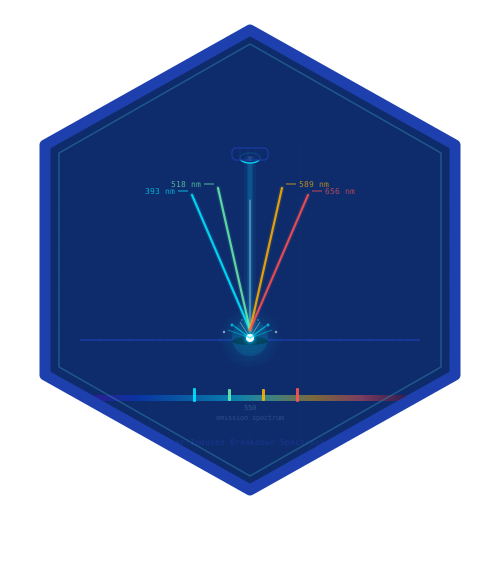
Identifies emission channels that best discriminate two tissue types via per-wavelength t-tests with Benjamini-Hochberg FDR correction, plus log2 fold-change. Optionally matches significant channels to NIST elements.
Usage
ls_tissue_discriminate(
  dataset,
  group_col,
  group_a,
  group_b,
  method = "t_test",
  tolerance_nm = 0.2
)
Arguments
- dataset
A
ls_dataset()with tissue labels.- group_col
Character. Label column in
sample_info.- group_a
Character. First group label.
- group_b
Character. Second group label.
- method
Character.
"t_test"(default) or"fold_change".- tolerance_nm
Numeric. Matching tolerance when annotating elements. Default 0.2.
Value
A tibble::tibble() with columns wavelength_nm, mean_a,
mean_b, p_value, fold_change, fdr, significant, element.
Examples
ds <- ls_example_data("tissue")
head(ls_tissue_discriminate(ds, "tissue", "bone", "muscle"))
#> # A tibble: 6 × 8
#>   wavelength_nm mean_a mean_b   p_value fold_change      fdr significant element
#>           <dbl>  <dbl>  <dbl>     <dbl>       <dbl>    <dbl> <lgl>       <chr>
#> 1          719.   78.4   41.7 3.18 e-10       0.894  1.84e-7 FALSE       NA
#> 2          432.   87.0   68.4 3.59 e-10       0.343  1.84e-7 FALSE       NA
#> 3          647.  121.    47.3 9.08 e-10       1.34   2.56e-7 TRUE        NA
#> 4          866.   47.4   32.5 1.000e- 9       0.532  2.56e-7 FALSE       NA
#> 5          715.  101.    41.8 2.02 e- 9       1.25   3.04e-7 TRUE        NA
#> 6          656.  110.    46.3 1.96 e- 9       1.23   3.04e-7 TRUE        H