annotatR provides multi-layer region-of-interest (ROI) annotation for whole-slide microscopy images, hyperspectral data cubes, and conventional rasters. Annotations are validated simple-feature geometries stored in image pixel coordinates with explicit pyramid-level transforms, and rasterise to binary, labelled, or multi-class integer masks for downstream segmentation and classification. A batch annotation application supports resumable sessions across image queues, live mask preview, and export to GeoJSON, QuPath, and TIFF.
Installation
# install.packages("pak")
pak::pak("CTTIR/annotatR")
Quick start
library(annotatR)

# Read a bundled example image and build a project with one annotation layer.
img <- at_example_image("tissue")
proj <- at_project(img, at_layer("regions", labels = c("tumour", "stroma")))

# Add regions of interest.
proj <- proj |>
  at_add_roi("regions", at_roi_rect(120, 150, 260, 290, label = "tumour")) |>
  at_add_roi("regions", at_roi_circle(400, 120, 60, label = "stroma"))

at_rois(proj)[, c("roi_id", "label", "area_px")]
#> # A tibble: 2 × 3
#>   roi_id        label  area_px
#>   <chr>         <chr>    <dbl>
#> 1 roi_000000001 tumour  19600
#> 2 roi_000000002 stroma  11292.

# Rasterise to a labelled mask (the "Schablone") and write it with a legend.
mask <- at_mask(proj, type = "labelled")
path <- tempfile(fileext = ".tif")
at_write_mask(mask, path)             # also writes <path>.legend.json
at_plot_overlay(proj)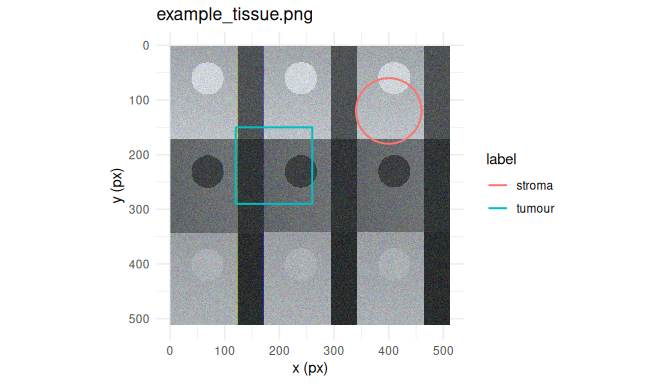
Supported formats
| Format | Backend | Package required | Pyramid | Spectral |
|---|---|---|---|---|
| PNG / JPEG / TIFF | raster |
magick or tiff | no | no |
| Pyramidal / OME-TIFF | tiff |
tiff | yes | multiplex |
| qptiff, OME-TIFF | ometiff |
RBioFormats | yes | multiplex |
Cubert .cu3s
|
cuvis |
cuvis.r + CUVIS SDK | no | yes |
| ENVI cube (BSQ/BIL/BIP) | envi |
base R, windowed reads | no | yes |
| Diaspective Vision TIVITA | tivita |
base R, declared profile or sidecar | no | yes |
A TIFF is treated as spectral only when wavelengths are declared. at_bands(), at_hsi_meta() and at_read_stats() report band wavelengths and gaps, value units, calibration and transform digests, and the bytes actually read.
The mask workflow
A mask is the central output artifact: a binary, labelled, or multi-class integer raster derived from your annotations, exportable at any pyramid level and self-describing via a sidecar JSON legend. Masks feed segmentation, classification, and spectral-extraction pipelines in Python, ImageJ, QuPath, or R. See vignette("masks") for the pixel-coverage contract and downstream consumption.
The annotation app
# Launch the batch annotation app over a queue of images:
at_annotate(at_example_session(5))
Iterate through an image queue, draw multi-layer ROIs, watch the mask render live, and export everything in one pass — with resumable sessions and keyboard-first throughput. at_app() returns the same app as a shiny.appobj for embedding and testing.
Working with qupflowR
annotatR exchanges annotations with the qupflowR package through a versioned, hash-inventoried contract. at_interop_capabilities() reports which profiles this installation supports; the file (I0) and R API (I1) profiles are supported, while direct app control (I2) and embedding (I3) stay planned until they are qualified against a real qupflowR client.
dest <- file.path(tempdir(), "handoff")
receipt <- at_export_qupflowr(proj, dest)            # QuPath GeoJSON, masks, manifest, integrity
report <- at_import_qupflowr(dest)                    # verified, namespaced, never runs analysis
patch <- at_stage_qupflowr(proj, report)              # diff; reviewed ROIs become conflicts
committed <- at_commit_qupflowr(patch, idempotency_key = "review-42")
at_training_export() writes leakage-free, grouped deep-learning datasets with integer masks and full provenance, and at_training_import() stages model predictions for review. An optional loopback control service (at_control_start(), protocol annotatr-control-v1) lets a partner process read state and events and send typed commands to a running app. See vignette("partner-interop").
Related work
Unlike QuPath, the ImageJ ROI Manager, napari, or Annotorious, annotatR is R-native and script-first, handles hyperspectral cubes alongside microscopy, and treats the batch mask export as a first-class, reproducible artifact.
Use of LLM tools
Portions of this package were prepared with assistance from large language model tooling for narrowly defined, non-authorial tasks: copyediting, prose smoothing, Markdown/LaTeX formatting, scaffolding of boilerplate files (CI configs, build scripts), code refactoring. The tools used were Chat AI, the LLM service of KISSKI (GWDG), and a self-hosted Mistral Small (24B, Apache-2.0) run locally via Ollama and the ollamar R package — local inference only, with no data sent to third parties for the self-hosted model.