



What pressR does
pressR parses, analyzes, and visualizes pressure distribution data from capacitive sensor systems. It provides:
- Predefined sensor layouts (in-shoe insoles, pressure platforms, saddle mats, seating mats, glove sensors),
- Parsers for ASCII and CSV pressure data files,
- A full analysis pipeline (per-frame metrics, trial summaries, regional analysis, gait-cycle detection, saddle-fit checks),
-
ggplot2-based visualization and composite reports, - An interactive Shiny application for data exploration.
Load a layout
Every trial is tied to a pr_layout object that describes
the sensor geometry. For example, a 99-sensor in-shoe pressure
insole:
layout <- pr_layout_insole()
print(layout)
#>
#> ── pr_layout: insole_standard ──────────────────────────────────────────────────
#> In-shoe pressure insole (99 sensors, standard).
#> • Manufacturer: ""
#> • Model: "insole"
#> • Grid: 18 x 8
#> • Active sensors: 99
#> • Sensor area: 1.5 cm²
#> • Pressure range: 0 - 1200 kPa
#> • Regions: 7
#> Region names: "heel", "midfoot", "metatarsal_1", "metatarsal_2_3",
#> "metatarsal_4_5", "hallux", and "lesser_toes"
Generate a synthetic example trial
pr_example_trial() produces realistic synthetic data for
each supported application. This is useful for quick demos, tests, and
vignettes.
trial <- pr_example_trial("insole")
trial
#>
#> ── pr_trial ────────────────────────────────────────────────────────────────────
#> • System: "insole"
#> • Layout: "insole_standard"
#> • Frames: 250
#> • Duration: 5 s
#> • Sampling: 50 Hz
#> • Sensors: 99
#> • Subject: "EX01"
#> • Date: "2026-08-22"
#> • Condition: "walking"
Visualize
The default plot method draws a maximum-pressure picture (MPP):
pr_plot_heatmap(trial)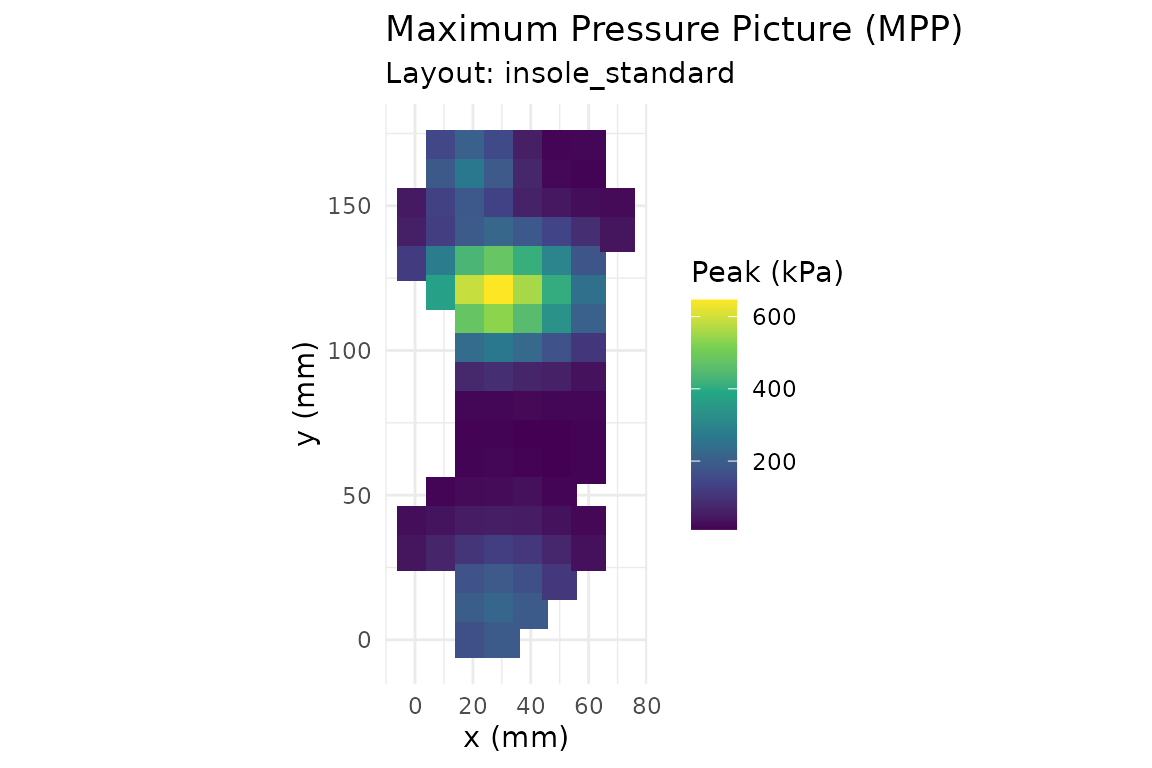
Time-domain curves are equally straightforward:
pr_plot_force_time(trial, show_cycles = TRUE)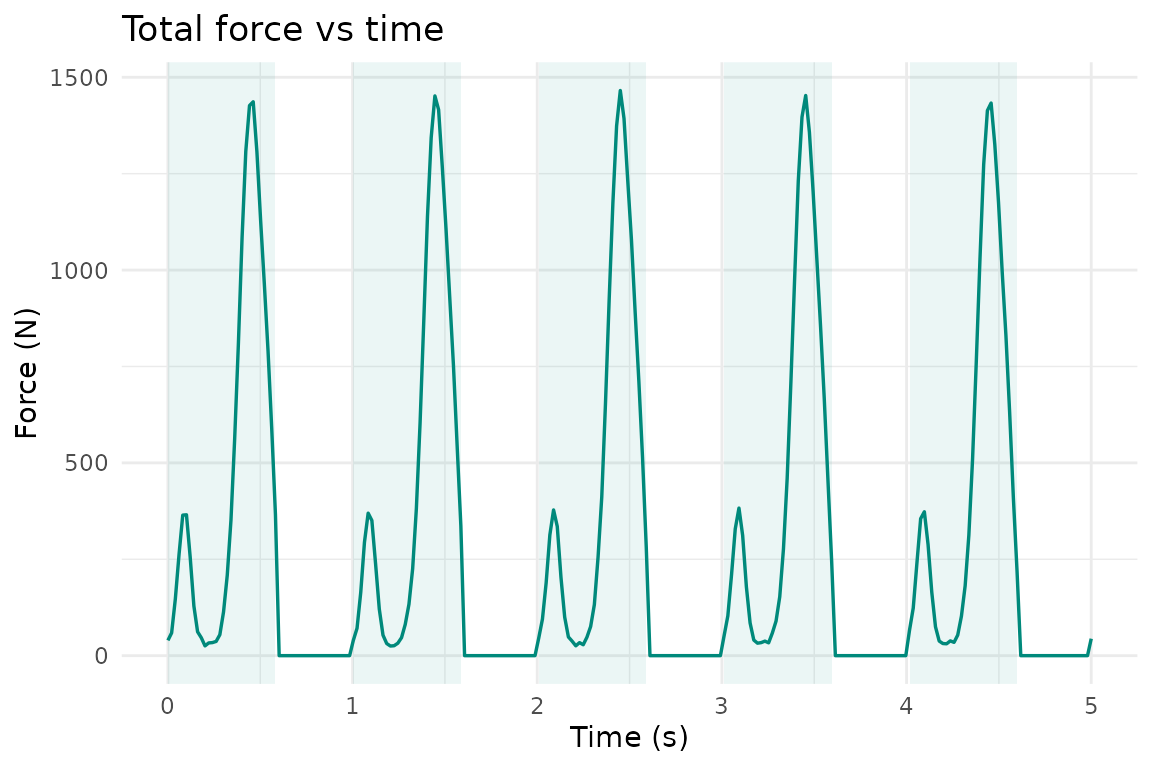
Summarize
pr_summary() returns a single-row tibble containing the
common biomechanical parameters:
pr_summary(trial)
#> # A tibble: 1 × 14
#>     mpp   mvp max_force mean_force max_contact_area mean_contact_area
#>   <dbl> <dbl>     <dbl>      <dbl>            <dbl>             <dbl>
#> 1  646.  43.0     1466.       289.             128.              60.9
#> # ℹ 8 more variables: contact_time <dbl>, pti_max <dbl>, pti_mean <dbl>,
#> #   impulse <dbl>, cop_path_length <dbl>, cop_velocity_mean <dbl>,
#> #   cop_range_ap <dbl>, cop_range_ml <dbl>
Regional analysis
With the insole layout’s default region masks you get one row per anatomical region:
pr_calc_regional(trial)
#> # A tibble: 7 × 6
#>   region           mpp   mvp max_force contact_area pti_mean
#>   <chr>          <dbl> <dbl>     <dbl>        <dbl>    <dbl>
#> 1 heel            220.  15.0     357.          42       40.2
#> 2 midfoot         646.  59.6    1248.          61.5    155.
#> 3 metatarsal_1    130.  23.0      41.9          6       65.4
#> 4 metatarsal_2_3  224.  43.3     116.           9      127.
#> 5 metatarsal_4_5  137.  15.9      49.1          9       43.8
#> 6 hallux          265.  29.9     120.           6       83.8
#> 7 lesser_toes     190.  12.9      73.1         12       30.0
Export
Results can be exported as CSV:
tmp <- tempfile(fileext = ".csv")
pr_export_csv(trial, tmp, what = "summary")
Launch the Shiny app
pr_run_app(trial)Use of LLM tools
Portions of this package were prepared with assistance from large
language model tooling for narrowly defined, non-authorial tasks:
copyediting, prose smoothing, Markdown/LaTeX formatting, scaffolding of
boilerplate files (CI configs, build scripts), code refactoring. The
tools used were Chat AI,
the LLM service of KISSKI (GWDG), and a self-hosted Mistral
Small (24B, Apache-2.0) run locally via Ollama and the ollamar R
package — local inference only, with no data sent to third parties for
the self-hosted model.
All scientific claims, methodological choices, analyses, interpretations, and conclusions are the author’s own. No LLM-generated text was incorporated without review and revision, and every reference was verified against its DOI, arXiv ID, or ISBN.