Research-management analytics: coverage, attribution, and policy evaluation
Source:vignettes/research-management-analytics.Rmd
research-management-analytics.Rmd



This article walks an end-to-end research-management study: auditing an institution’s publication output against a ground-truth tracker, capturing affiliations robustly, evaluating whether an intervention changed output, and summarising impact defensibly. Everything runs on synthetic example data.
A reproducible starting corpus
For arbitrary tabular sources, sm_corpus_from_tables()
is the recommended ingestion path: it validates required columns,
coerces types, fills missing optional tables, and returns a valid
sm_corpus.
works <- data.frame(
  work_id = paste0("W", 1:4),
  title = c("Spatial transcriptomics in cancer",
            "Immune checkpoint resistance",
            "A trial of biomarker discovery",
            "Single-cell atlas of the tumour"),
  year = c("2018", "2019", "2020", "2021"),   # character -> coerced to integer
  doi = paste0("10.1234/example.", 1:4),
  cited_by_count = c(40, 12, 5, 1)
)
corpus <- sm_corpus_from_tables(list(works = works))
corpus
For the rest of the article we use the larger built-in synthetic corpus.
corpus <- sm_example_corpus(n_works = 200, seed = 1)1. Coverage auditing
Suppose a manual tracker lists the works the institution should have. We can measure recall and precision of the corpus against it, and see which years are worst covered.
reference <- corpus$works[1:150, c("work_id", "doi", "title", "year")]
names(reference)[1] <- "id"

cov <- sm_coverage_audit(corpus, reference, by = "year", match = "doi")
cov
summary(cov)
#> # A tibble: 1 × 8
#>   recall precision    f1 n_corpus n_reference n_matched n_corpus_only
#>    <dbl>     <dbl> <dbl>    <int>       <int>     <int>         <int>
#> 1      1      0.75 0.857      200         150       150            50
#> # ℹ 1 more variable: n_reference_only <int>
ggplot2::autoplot(cov)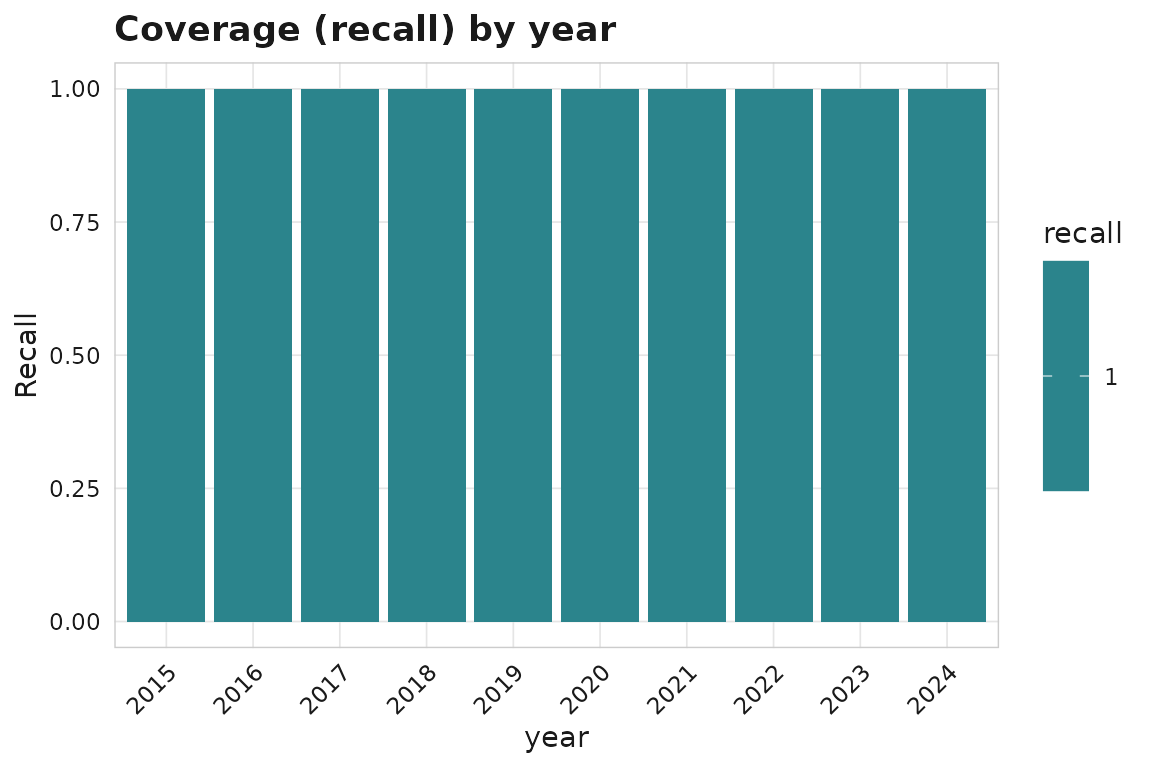
Breakdowns are returned as a single flat tibble; use
sm_coverage_breakdowns() to access or filter them:
sm_coverage_breakdowns(cov, dimension = "year")
#> # A tibble: 10 × 8
#>    dimension level n_reference n_matched recall n_corpus precision    f1
#>    <chr>     <chr>       <int>     <int>  <dbl>    <int>     <dbl> <dbl>
#>  1 year      2015           18        18      1       24     0.75  0.857
#>  2 year      2016           12        12      1       17     0.706 0.828
#>  3 year      2017           15        15      1       20     0.75  0.857
#>  4 year      2018           16        16      1       20     0.8   0.889
#>  5 year      2019           19        19      1       25     0.76  0.864
#>  6 year      2020            9         9      1       15     0.6   0.75
#>  7 year      2021           16        16      1       20     0.8   0.889
#>  8 year      2022           13        13      1       19     0.684 0.812
#>  9 year      2023           17        17      1       20     0.85  0.919
#> 10 year      2024           15        15      1       20     0.75  0.857
Source coverage can be checked against a journal master list by ISSN
(sm_journal_in_index()), and two corpora reconciled by
content with sm_reconcile().
ref_index <- utils::read.csv(
  system.file("extdata", "example_journal_index.csv", package = "scimapR"),
  stringsAsFactors = FALSE
)
sm_journal_in_index(c("1078-8956", "9999-9999"), index = "doaj",
                    reference_list = ref_index)
#> # A tibble: 2 × 5
#>   issn      index in_index matched_title   matched_issn_type
#>   <chr>     <chr> <lgl>    <chr>           <chr>
#> 1 1078-8956 doaj  TRUE     Nature Medicine print
#> 2 9999-9999 doaj  FALSE    NA              NA
Passing the same index to
sm_coverage_audit(index_table = ) assesses record
capture and journal indexability together – “did we
capture this paper” and “is its journal indexed” in one pass:
cov_idx <- sm_coverage_audit(corpus, reference, match = "doi",
                             index_table = ref_index)
cov_idx$indexability
#> # A tibble: 1 × 2
#>   indexable n_records
#>   <lgl>         <int>
#> 1 FALSE           200
2. Affiliation capture and attribution
Hand-rolled affiliation regex is brittle.
sm_affiliation_match() uses a maintained, extensible
dictionary (with multilingual variants and an email-domain fallback),
and sm_attribute_institution() rolls matches up to a
controlled vocabulary.
corpus$authorships$raw_affiliation[1:3] <- c(
  "Bundeswehrkrankenhaus Berlin",
  "Charite - Universitatsmedizin Berlin",
  "Walter Reed Army Institute of Research"
)
corpus <- sm_affiliation_match(corpus)
ror <- utils::read.csv(
  system.file("extdata", "example_ror.csv", package = "scimapR"),
  stringsAsFactors = FALSE
)
corpus <- sm_attribute_institution(corpus, vocabulary = "ror", ror_table = ror)
match_signal is a factor with an exported, stable level
set (sm_affiliation_signals()), so you can filter reliably
— for example to keep only name-token matches and inspect the evidence
that triggered them:
sm_affiliation_signals()
#> [1] "name_token"   "email_domain" "postcode"     "none"
summary_tbl <- sm_affiliation_summary(corpus)
subset(summary_tbl, match_signal == "name_token",
       select = c(institution, match_signal, n_works, example_evidence))
#> # A tibble: 3 × 4
#>   institution         match_signal n_works example_evidence
#>   <chr>               <fct>          <int> <chr>
#> 1 Bundeswehr Hospital name_token         1 Bundeswehrkrankenhaus
#> 2 Charite Berlin      name_token         1 Charite
#> 3 Walter Reed         name_token         1 Walter Reed
The example_evidence column (and the per-authorship
match_evidence column) give an audit trail: which signal
matched, on what string.
Stability. Accessors like
sm_affiliation_summary()andsm_coverage_breakdowns(tidy = TRUE)follow scimapR’s accessor return-type contract (?scimapR-stability): their documented columns change only via alifecycledeprecation, so pipelines built on them do not break across releases.
3. Policy evaluation
Did an intervention in 2020 change output? An interrupted time series fits a level shift and slope change with a counterfactual.
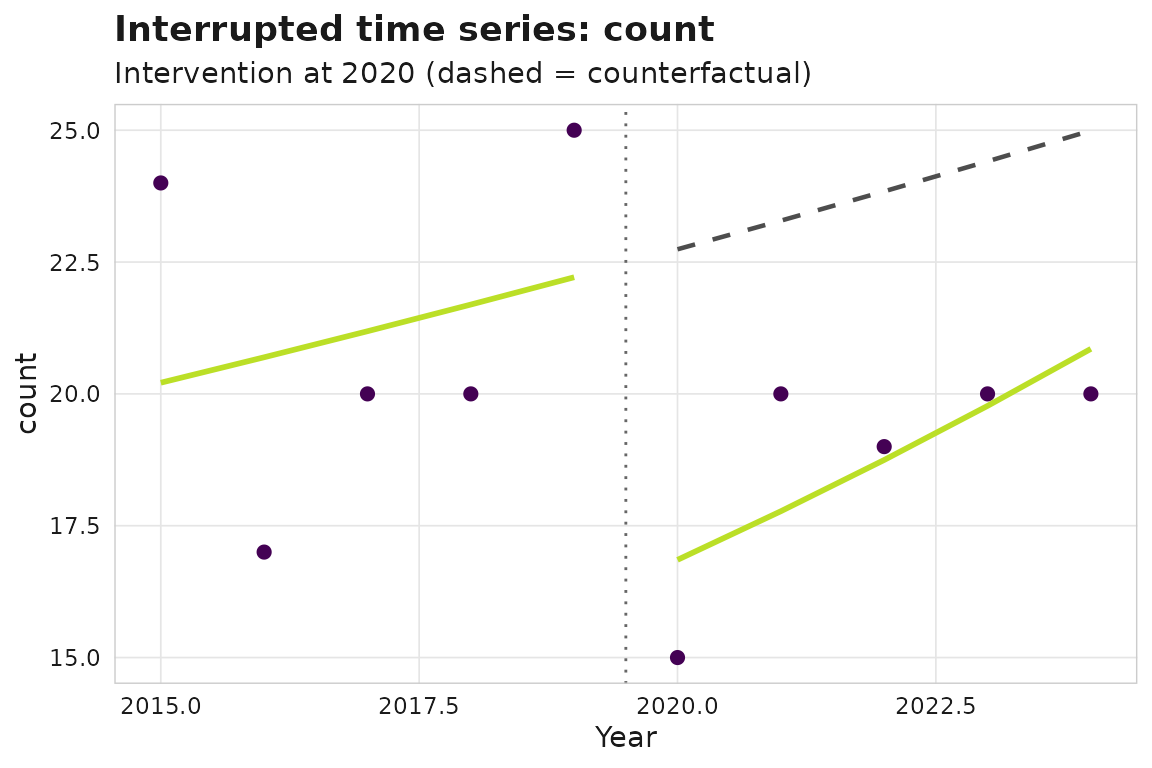
For citation-based outcomes, citation-immature recent years are
excluded automatically (sm_citation_maturity() exposes the
same flags on works).
A treated-vs-control comparison uses difference-in-differences. Here we tag two illustrative institution groups.
4. Counting and robust impact
Fractional counting attributes a multi-author paper’s single unit of credit across its contributors.
head(sm_count(corpus, method = "fractional", level = "author"), 5)
#> # A tibble: 5 × 5
#>   entity_id  entity_name    n_works credit weighted_citations
#>   <chr>      <chr>            <int>  <dbl>              <dbl>
#> 1 A000000001 Raj Fischer         41  10.2               191.
#> 2 A000000049 Mohammed Liu        16   4.79              103.
#> 3 A000000060 Mohammed Kumar      13   4.68               64.3
#> 4 A000000070 Mei Mueller         13   4.38               91.3
#> 5 A000000041 Raj Andersson       11   4.16               79.9
Heavy-tailed metrics are summarised robustly with medians, bootstrap CIs, and the proportion of papers in the global top 10%.
sm_metric_summary(corpus, metric = "citations", seed = 1, n_boot = 500)
#> # A tibble: 1 × 8
#>   metric        n  mean median median_ci_low median_ci_high pp_top10 n_boot
#>   <chr>     <int> <dbl>  <dbl>         <dbl>          <dbl>    <dbl>  <int>
#> 1 citations   200  15.6     13            11           15.5      0.1    500
5. Reproducible reporting
Finally, sm_figure_manifest() turns a directory of
exported figures into a captions / alt-text manifest for the
manuscript.
dir <- withr::local_tempdir()
gg <- ggplot2::autoplot(its)
ggplot2::ggsave(file.path(dir, "fig_its.png"), gg, width = 6, height = 4,
                dpi = 150)
sm_figure_manifest(dir)
#> # A tibble: 1 × 6
#>   file        caption alt_text width height   dpi
#>   <chr>       <chr>   <chr>    <int>  <int> <dbl>
#> 1 fig_its.png ""      ""         900    600    59
Together these functions cover the recurring tasks of a
research-coverage and impact study — audit, affiliation capture, policy
evaluation, robust summarisation, and reporting — on top of the
reproducible sm_corpus foundation.