library(tidyverse)
set.seed(42)
theme_set(theme_minimal(base_size = 12))Week 2, Session 4 — Discrete distributions: Bernoulli, binomial, Poisson
Course 1 — #courses
Note
Inference labs use the five-step template: Hypothesis → Visualise → Assumptions → Conduct → Conclude.
Learning objectives
- Simulate Bernoulli trials and aggregate them to a binomial.
- Show the Poisson approximation to the binomial when n is large and p is small.
- Use
dbinom(),pbinom(), andrbinom()(and their Poisson counterparts) to answer probability questions.
Prerequisites
Lab 2.2 (probability).
Background
The Bernoulli distribution is the simplest non-trivial distribution: one coin, two outcomes, a single probability p. The binomial adds structure — n independent Bernoulli trials with the same p — and gives the distribution of the count of successes. The Poisson arises in the limit where n is large, p is small, and np stays fixed; it describes counts of rare events over a fixed window of opportunity, without needing to specify n and p separately.
Most count-like quantities in biomedicine can be modelled by one of these three. Whether a tumour is responding (Bernoulli), how many of twenty patients relapse (binomial), how many emergency admissions arrive in an hour (Poisson) — the same three distributions cover a great deal of ground. The simulation-first approach makes them concrete before we write a formula.
There is a common conflation between the binomial and the Poisson in the clinical literature. When the sample size is large and the event is rare, the two distributions give nearly identical probabilities and either is defensible. When the event is not rare, the Poisson can assign meaningful probability to impossible events (more successes than trials), so the binomial is strictly better.
Setup
1. Hypothesis
We characterise three discrete distributions by simulation, then compare the empirical frequencies to the theoretical probabilities. No hypothesis is tested.
2. Visualise
A Bernoulli trial: one coin, success probability 0.3.
n_trials <- 1000
bern <- rbinom(n_trials, 1, 0.3)
mean(bern)   # empirical p
[1] 0.293A binomial count: how many successes in 20 trials each at p = 0.3, repeated 10,000 times.
n_rep <- 10000
bin  <- rbinom(n_rep, size = 20, prob = 0.3)

bin_tibble <- tibble(k = bin) |>
  count(k) |>
  mutate(prop = n / sum(n),
         theo = dbinom(k, 20, 0.3))
bin_tibble |>
ggplot(aes(k, prop)) +
geom_col(fill = "grey70", alpha = 0.8) +
geom_point(aes(y = theo), colour = "firebrick", size = 2) +
labs(x = "Successes in 20 trials",
y = "Proportion (bars) vs. P(k) (points)")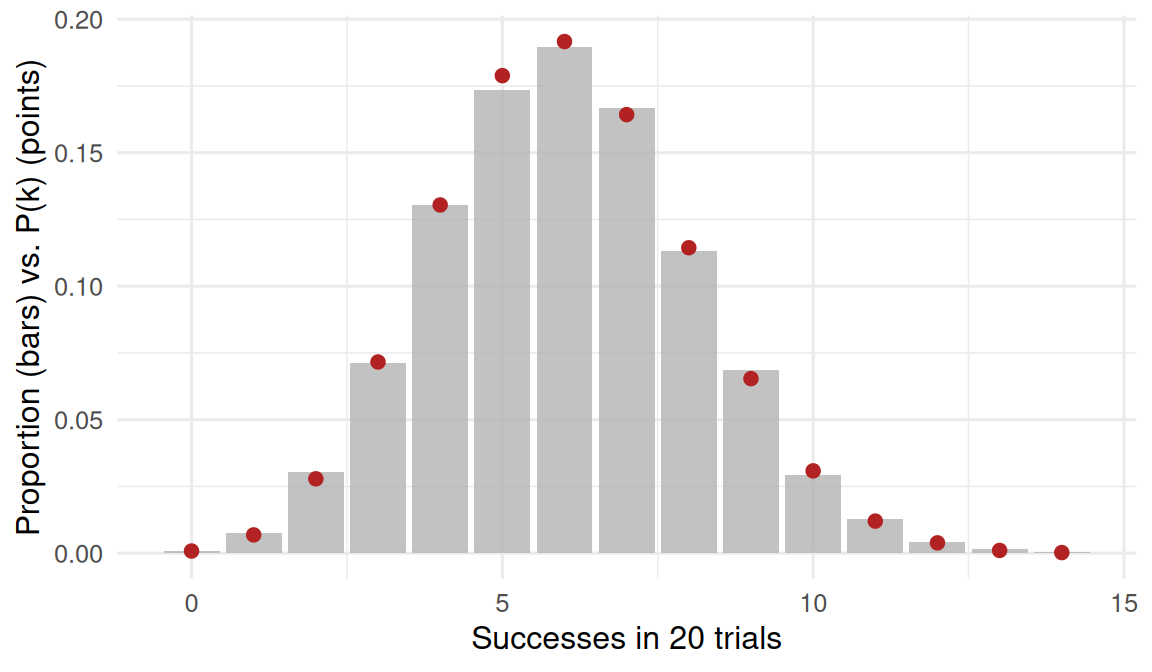
3. Assumptions
Binomial assumes fixed n, independence, and constant p. Poisson assumes a constant rate and independent counts over disjoint intervals. When n is large and p is small with np = λ, the binomial approaches Poisson.
# n=1000, p=0.003, so np = 3. Compare binomial and Poisson probabilities.
probs <- tibble(
  k = 0:10,
  binom  = dbinom(k, 1000, 0.003),
  pois   = dpois(k, 3)
)
probs
# A tibble: 11 × 3
k binom pois
<int> <dbl> <dbl>
1 0 0.0496 0.0498
2 1 0.149 0.149
3 2 0.224 0.224
4 3 0.224 0.224
5 4 0.168 0.168
6 5 0.101 0.101
7 6 0.0503 0.0504
8 7 0.0215 0.0216
9 8 0.00803 0.00810
10 9 0.00266 0.00270
11 10 0.000794 0.0008104. Conduct
Answer two specific questions.
# Q1: In a trial of 20 patients at p=0.3 response rate, what is
# P(at least 8 responders)?
p_ge8 <- 1 - pbinom(7, size = 20, prob = 0.3)
p_ge8
[1] 0.2277282# Q2: An ER admits patients at a rate of 3/hour. What is
# P(7 or more patients in a given hour)?
p_pois_ge7 <- 1 - ppois(6, lambda = 3)
p_pois_ge7[1] 0.03350854Simulate Q2 to confirm.
sim <- rpois(10000, lambda = 3)
mean(sim >= 7)
[1] 0.0354tibble(k = 0:15) |>
mutate(pois_density = dpois(k, 3)) |>
ggplot(aes(k, pois_density)) +
geom_col(fill = "steelblue") +
labs(x = "Number of events", y = "P(X = k)")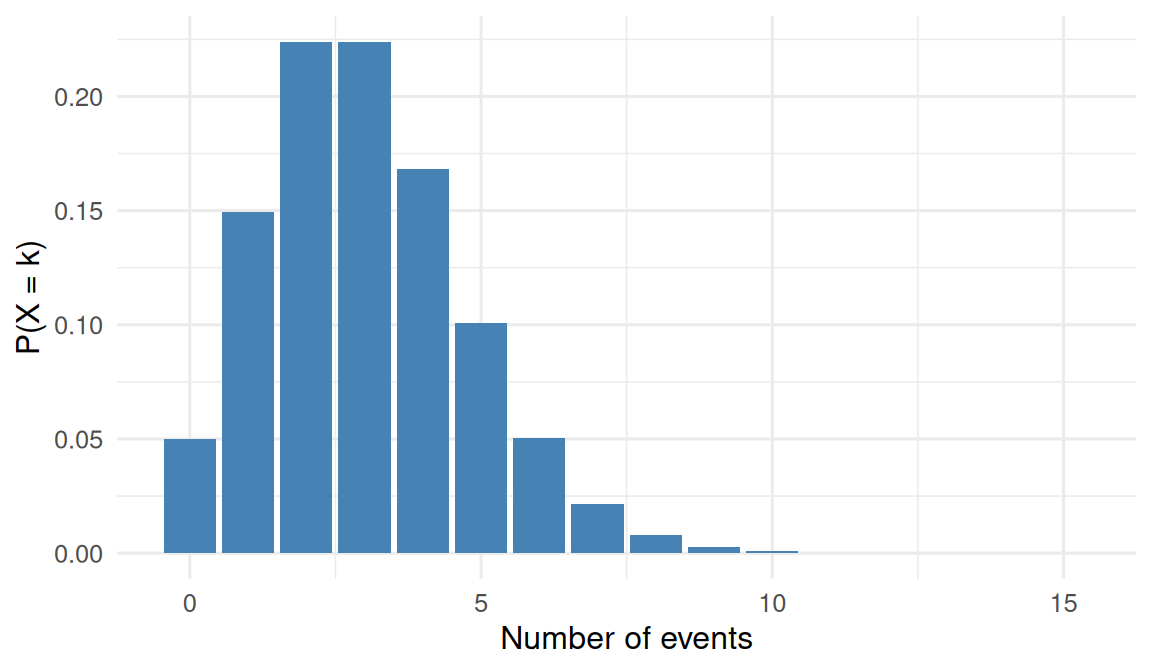
5. Concluding statement
A response rate of 0.3 in a 20-patient trial implies a probability of 0.228 of observing eight or more responders. An ER with a mean admission rate of 3/hour has a probability of 0.034 of receiving seven or more admissions in a given hour; 10,000 simulated hours recovered an empirical proportion of 0.035. The binomial with n = 1000, p = 0.003 and the Poisson with λ = 3 gave nearly indistinguishable probabilities across k = 0–10.
Discrete distributions are under-appreciated. Many designs that are reached for as continuous (eg regressions on a rate) have a cleaner count-based model sitting next to them.
Make the binomial → Poisson limit visible: plot the two PMFs on the same axes at decreasing p and watch them converge.
Common pitfalls
- Using the normal approximation to the binomial when n is small. For small n use
pbinom()directly. - Modelling a rate as a proportion when the denominator is person-time, not persons.
- Treating a Poisson with a known λ as if its variance had to be estimated. For Poisson, mean = variance.
Further reading
- Rosner B. Fundamentals of Biostatistics, chapter on discrete distributions.
- Agresti A. Categorical Data Analysis, opening chapter.
Session info
sessionInfo()R version 4.5.2 (2025-10-31 ucrt)
Platform: x86_64-w64-mingw32/x64
Running under: Windows 11 x64 (build 26200)
Matrix products: default
LAPACK version 3.12.1
locale:
[1] LC_COLLATE=English_Germany.utf8 LC_CTYPE=English_Germany.utf8
[3] LC_MONETARY=English_Germany.utf8 LC_NUMERIC=C
[5] LC_TIME=English_Germany.utf8
time zone: Europe/Berlin
tzcode source: internal
attached base packages:
[1] stats graphics grDevices utils datasets methods base
other attached packages:
[1] lubridate_1.9.5 forcats_1.0.1 stringr_1.6.0 dplyr_1.2.1
[5] purrr_1.2.2 readr_2.2.0 tidyr_1.3.2 tibble_3.3.1
[9] ggplot2_4.0.3 tidyverse_2.0.0
loaded via a namespace (and not attached):
[1] gtable_0.3.6 jsonlite_2.0.0 compiler_4.5.2 tidyselect_1.2.1
[5] scales_1.4.0 yaml_2.3.12 fastmap_1.2.0 R6_2.6.1
[9] labeling_0.4.3 generics_0.1.4 knitr_1.51 htmlwidgets_1.6.4
[13] pillar_1.11.1 RColorBrewer_1.1-3 tzdb_0.5.0 rlang_1.2.0
[17] stringi_1.8.7 xfun_0.57 S7_0.2.2 otel_0.2.0
[21] timechange_0.4.0 cli_3.6.6 withr_3.0.2 magrittr_2.0.4
[25] digest_0.6.39 grid_4.5.2 hms_1.1.4 lifecycle_1.0.5
[29] vctrs_0.7.3 evaluate_1.0.5 glue_1.8.1 farver_2.1.2
[33] rmarkdown_2.31 tools_4.5.2 pkgconfig_2.0.3 htmltools_0.5.9