

molpathR is a unified molecular pathology data platform that ingests heterogeneous clinical and genomic data sources (VCF, BAM, FASTQ, XML reports, PDF reports, clinical information systems, survival data), builds a queryable in-memory database from explicitly identified records, and provides an interactive Shiny application for exploratory cohort analysis. Raw FASTQ/BAM readers expose sequences and alignments separately; they do not perform variant calling or clinical interpretation. Unknown patient links and annotations remain unknown. The package has not been qualified for diagnostic decision making.
Installation
Use R 4.1 or later. On Windows and macOS, install the CRAN binaries from R:
install.packages("pdftools", repos = "https://cloud.r-project.org")For a source installation of pdftools, install its system library first:
# Debian or Ubuntu
sudo apt-get install libpoppler-cpp-dev
# macOS with Homebrew, only when building pdftools from source
brew install poppler
See the pdftools installation requirements for other platforms. These commands assume R and the platform’s R compilation toolchain are already installed. Then install the development source:
install.packages("remotes", repos = "https://cloud.r-project.org")
remotes::install_github("cttir/molpathR")
Quick example
library(molpathR)

# Load example database with synthetic data
db <- mp_example_db(n_patients = 50, seed = 42)
db
#>
#> ── molpath_db ──────────────────────────────────────────────────────────────────
#> ℹ patients: 50 records x 5 columns
#> ℹ samples: 116 records x 5 columns
#> ℹ variants: 2151 records x 10 columns
#> ℹ reports: 116 records x 5 columns
#> ℹ clinical: 195 records x 5 columns
#> ℹ survival: 50 records x 5 columns
#> ℹ Sample date range: 2021-04-01 to 2025-06-26
#> ℹ Overall completeness: "93.7%"
#> ℹ Created: "2026-11-03 12:42:46"
#> ℹ Source files: 0

# Query pathogenic TP53 variants
tp53 <- mp_query_variants(db, genes = "TP53", classification = "Pathogenic")
head(tp53[, c("sample_id", "gene", "variant", "classification", "vaf")])
#> # A tibble: 6 × 5
#>   sample_id     gene  variant             classification   vaf
#>   <chr>         <chr> <chr>               <chr>          <dbl>
#> 1 SAM-2021-0010 TP53  TP53 deletion       Pathogenic     0.420
#> 2 SAM-2021-0011 TP53  TP53-UNKNOWN fusion Pathogenic     0.464
#> 3 SAM-2022-0013 TP53  TP53-UNKNOWN fusion Pathogenic     0.322
#> 4 SAM-2021-0017 TP53  TP53 loss           Pathogenic     0.214
#> 5 SAM-2022-0018 TP53  p.R282W             Pathogenic     0.250
#> 6 SAM-2023-0020 TP53  p.R248W             Pathogenic     0.213
# Survival analysis by diagnosis
mp_plot_survival(db, group_by = "diagnosis", type = "os")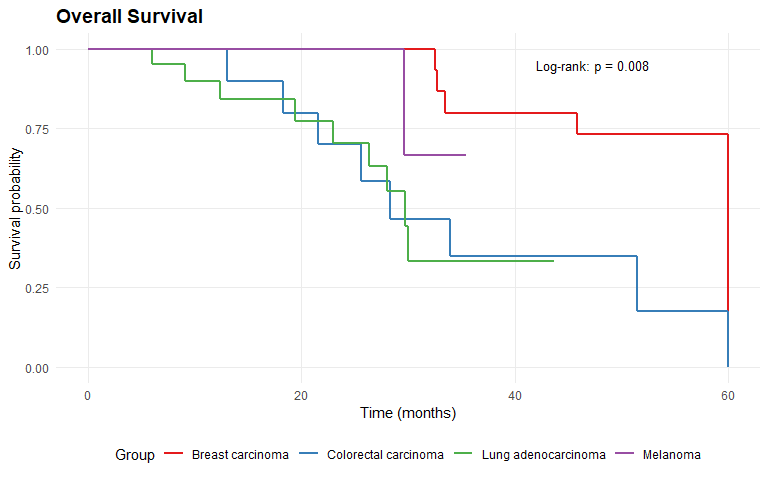
Launch the Shiny app
mp_run_app(db)Features
- Parsers for VCF, raw FASTQ/BAM, XML reports, PDF text, clinical exports and survival data
- Relational in-memory database linking patients, samples, variants, reports, clinical, and survival data
- Query engine with tidy evaluation and free-text search
- Exploratory plots: variant landscapes, mutation spectra, survival curves, cohort overviews
- Interactive Shiny application with 6 tabs for clinical exploration
Data integrity
mp_validate_db(db) reports incomplete patient/sample links, including missing parent tables. The constructor rejects malformed schemas, conflicting primary identities, impossible event codes and nonfinite measures. mp_save_db() verifies a staged file before replacement; mp_load_db() validates its contents. Resolve reported linkage issues before interpreting a cohort. Use one writer per saved file.
The data import guide contains a runnable synthetic pathology/clinical/survival import and explains VCF and raw-read boundaries. Optional Bioconductor packages provide BAM/FASTQ readers; strict text FASTQ and VCF paths are available as documented.
Citation
Run citation("molpathR") and record the package version (0.2.0) or commit used. No Zenodo deposit has been published for this version. The previously advertised draft DOI did not resolve during the maintenance audit; use the repository citation until a public deposit is verified.
License
MIT License. See LICENSE.md for details.
Use of LLM tools
Where applicable, LLM tools were used for narrowly defined, non-authorial tasks: copyediting, prose refinement, Markdown/LaTeX formatting, boilerplate scaffolding (such as CI configurations and build scripts), and code refactoring. Tools included Chat AI, the KISSKI (GWDG) service, and self-hosted Mistral Small (24B, Apache-2.0) served through a local vLLM architecture on an Ubuntu Linux workstation with Intel processors and NVIDIA GPUs. Self-hosted use also includes models that were further trained (fine-tuned) or weight-edited in-house for specific tasks. All self-hosted models ran locally, with no data sent to third parties.
All scientific claims, methodological choices, analyses, interpretations and conclusions remain the authors’ own. Where applicable, LLM-generated material must be reviewed and revised before inclusion, and references must be verified against their DOI, arXiv ID or ISBN.
Local software setup: vLLM with Python/PyTorch, plus R and RStudio.
Branding
Editable R artwork and regeneration instructions are in tools/branding.