

molpathR is a unified molecular pathology data platform that ingests heterogeneous clinical and genomic data sources (VCF, BAM, FASTQ, XML reports, PDF reports, clinical information systems, survival data), builds a queryable in-memory database, and provides an interactive Shiny application for clinical exploration and visualization.
Installation
Install the development version from GitHub:
# install.packages("remotes")
remotes::install_github("cttir/molpathR")
Quick example
library(molpathR)

# Load example database with synthetic data
db <- mp_example_db(n_patients = 50, seed = 42)
db
#>
#> ── molpath_db ──────────────────────────────────────────────────────────────────
#> ℹ patients: 50 records x 5 columns
#> ℹ samples: 116 records x 5 columns
#> ℹ variants: 2151 records x 10 columns
#> ℹ reports: 116 records x 5 columns
#> ℹ clinical: 195 records x 5 columns
#> ℹ survival: 50 records x 5 columns
#> ℹ Sample date range: 2021-04-01 to 2025-06-26
#> ℹ Overall completeness: "93.7%"
#> ℹ Created: "2026-06-22 13:47:32"
#> ℹ Source files: 0

# Query pathogenic TP53 variants
tp53 <- mp_query_variants(db, genes = "TP53", classification = "Pathogenic")
head(tp53[, c("sample_id", "gene", "variant", "classification", "vaf")])
#> # A tibble: 6 × 5
#>   sample_id     gene  variant             classification   vaf
#>   <chr>         <chr> <chr>               <chr>          <dbl>
#> 1 SAM-2021-0010 TP53  TP53 deletion       Pathogenic     0.420
#> 2 SAM-2021-0011 TP53  TP53-UNKNOWN fusion Pathogenic     0.464
#> 3 SAM-2022-0013 TP53  TP53-UNKNOWN fusion Pathogenic     0.322
#> 4 SAM-2021-0017 TP53  TP53 loss           Pathogenic     0.214
#> 5 SAM-2022-0018 TP53  p.R282W             Pathogenic     0.250
#> 6 SAM-2023-0020 TP53  p.R248W             Pathogenic     0.213
# Survival analysis by diagnosis
mp_plot_survival(db, group_by = "diagnosis", type = "os")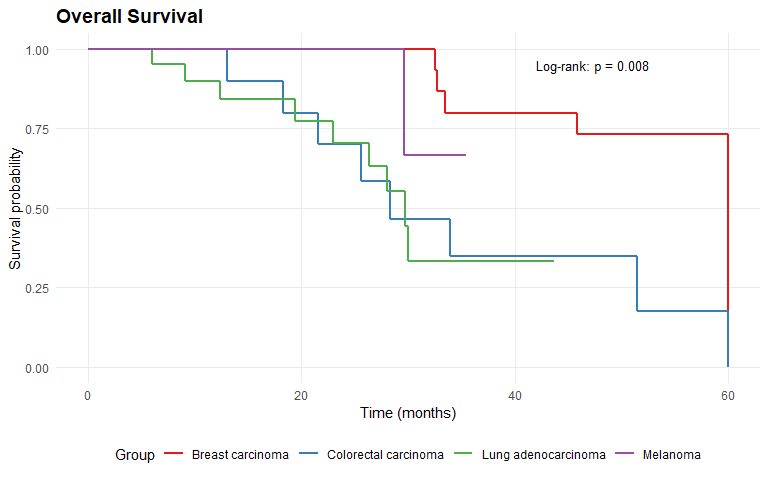
Launch the Shiny app
mp_run_app(db)Features
- Parsers for VCF, FASTQ, BAM, XML reports, PDF reports, clinical systems, and survival data
- Relational in-memory database linking patients, samples, variants, reports, clinical, and survival data
- Query engine with tidy evaluation and free-text search
- Publication-ready plots: variant landscapes, mutation spectra, survival curves, cohort overviews
- Interactive Shiny application with 6 tabs for clinical exploration
Use of LLM tools
Portions of this package were prepared with assistance from large language model tooling for narrowly defined, non-authorial tasks: copyediting, prose smoothing, Markdown/LaTeX formatting, scaffolding of boilerplate files (CI configs, build scripts), code refactoring. The tools used were Chat AI, the LLM service of KISSKI (GWDG), and a self-hosted Mistral Small (24B, Apache-2.0) run locally via Ollama and the ollamar R package — local inference only, with no data sent to third parties for the self-hosted model.
All scientific claims, methodological choices, analyses, interpretations, and conclusions are the author’s own. No LLM-generated text was incorporated without review and revision, and every reference was verified against its DOI, arXiv ID, or ISBN.
License
MIT License. See LICENSE.md for details.
Citation
If you use this software, please cite it as:
Heller, R. (2026). molpathR: Molecular pathology data platform for clinical NGS integration (Version 0.1.0) [Computer software]. Zenodo. https://doi.org/10.5281/zenodo.21889946