


What is scimapR?
scimapR is a comprehensive toolkit for bibliometric and scientometric analysis in R. It is designed as a complement to the foundational bibliometrix package, adding:
- Live corpus refresh with staleness tracking and locking
- Research questions as first-class objects with LLM-grounded screening
- Reproducible-by-construction corpus certificates for exact re-derivation
- Author trajectory analysis with topic pivots and collaborator turnover
- Equity and representation auditing with built-in epistemic humility
- LLM-grounded corpus chat with retrieval-constrained citations
Quick start
library(scimapR)

# Generate a synthetic example corpus
corpus <- sm_example_corpus(n_works = 100, seed = 42)
print(corpus)
#>
#> ── <sm_corpus> ─────────────────────────────────────────────────────────────────
#> Works: 100 | Authors: 80 | Institutions: 0
#> Years: 2015 - 2024
#> Sources (journals): 10
#> Embeddings: 100 x 64
#> Provenance: synthetic (100)
#> Status: Unlocked (last refreshed: 2026-08-22 13:19:44)
Exploring the corpus
# View works
head(corpus$works[, c("work_id", "title", "year", "cited_by_count")])
#> # A tibble: 6 × 4
#>   work_id    title                                           year cited_by_count
#>   <chr>      <chr>                                          <int>          <int>
#> 1 W000000001 Colorectal Cancer in colorectal cancer: a met…  2023             17
#> 2 W000000002 Drug Resistance in machine learning: a cohort…  2021             24
#> 3 W000000003 Spatial Transcriptomics in single-cell RNA-se…  2024             16
#> 4 W000000004 Single-Cell RNA-Seq in gene expression: a met…  2024             22
#> 5 W000000005 Immune Checkpoint in immune checkpoint: a pro…  2024              2
#> 6 W000000006 Biomarker Discovery in spatial transcriptomic…  2022             50
# View authors
head(corpus$authors[, c("author_id", "display_name")])
#> # A tibble: 6 × 2
#>   author_id  display_name
#>   <chr>      <chr>
#> 1 A000000001 Anna Garcia
#> 2 A000000002 Maria Kumar
#> 3 A000000003 Fatima Mueller
#> 4 A000000004 Yuki Kumar
#> 5 A000000005 David Brown
#> 6 A000000006 Hiroshi Sato
Visualisation
All plots use viridis colour palettes by default.
sm_plot_production(corpus)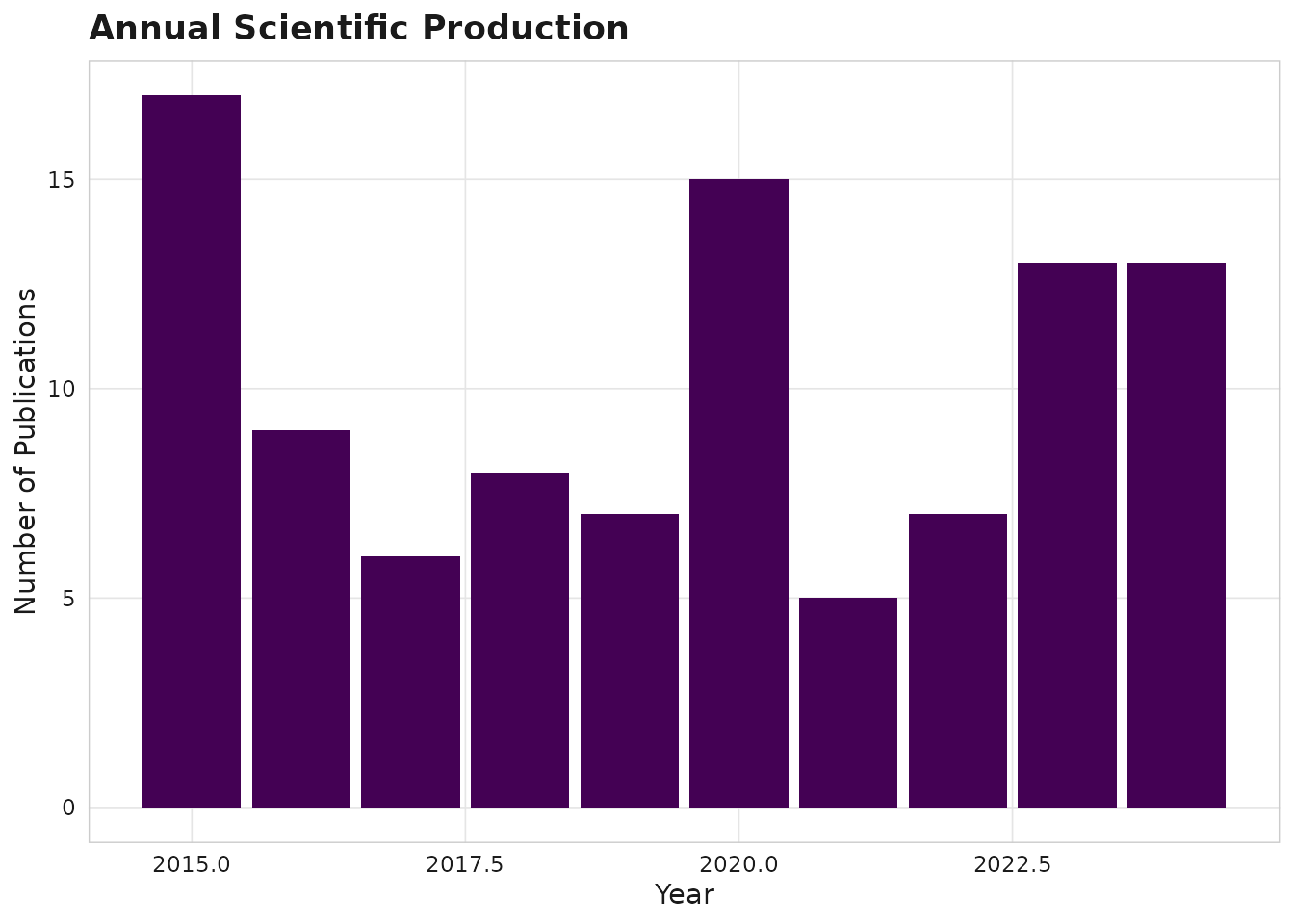
Annual production
sm_plot_top(corpus, level = "authors", n = 10)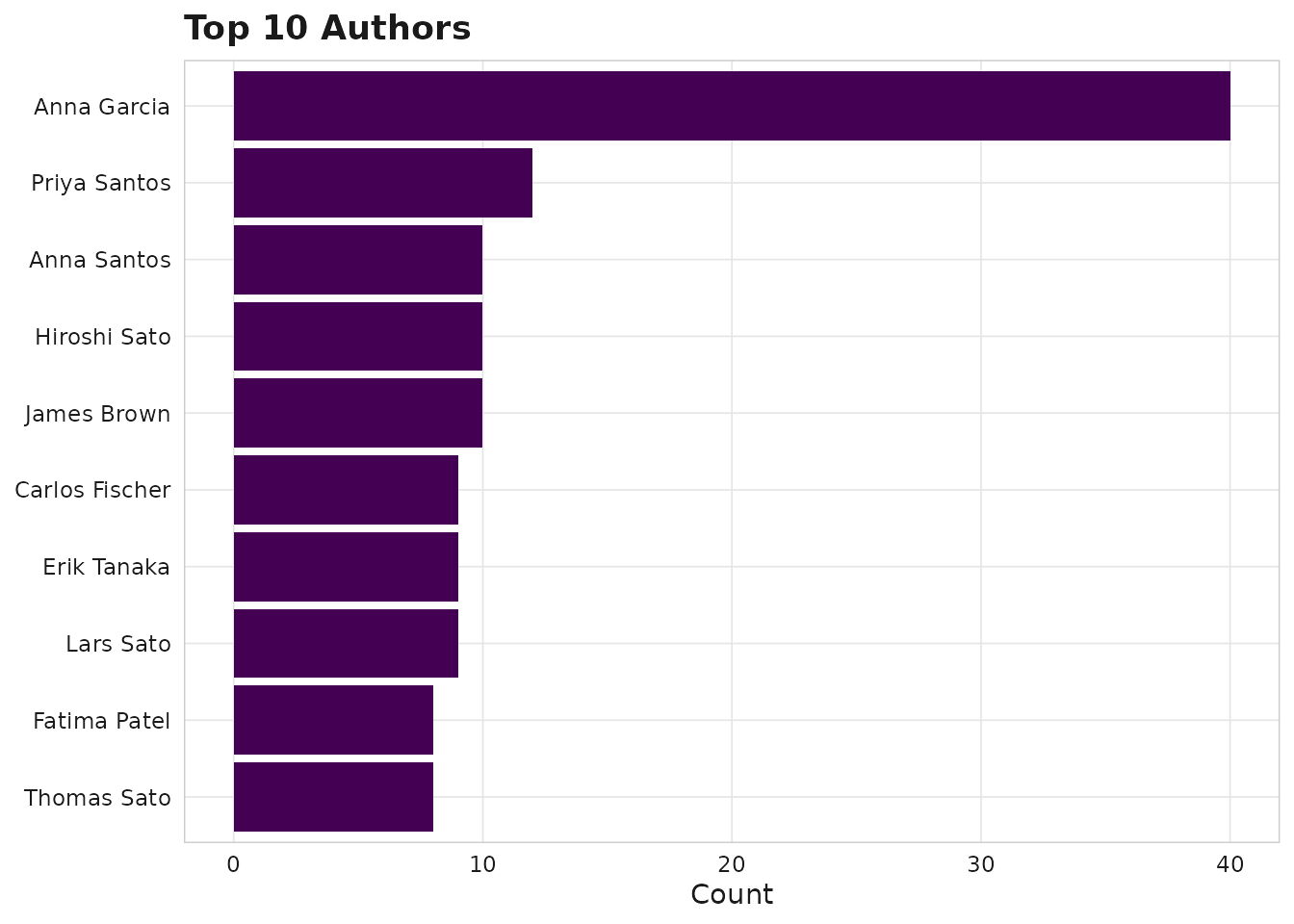
Top authors
Networks and large graphs
Network plots such as sm_plot_citation_network() and
sm_plot_collab() return ggraph objects whose
layout is computed lazily at print time. On large graphs that lazy
layout (and the embedded graph) can crash a knitr/callr/
workflowr render subprocess. For documents, pass
precompute = TRUE: the layout is computed eagerly and a
self-contained plain ggplot is returned, which you can
saveRDS() and print later in the document without
recomputing anything — even for a graph with a couple of thousand
nodes.
The max_nodes cap is opt-in
(NULL by default), so existing renders are never silently
downsampled; set it only when you deliberately want to bound a very
large graph (a cli message reports when it engages).
p <- sm_plot_citation_network(corpus, precompute = TRUE)
# saveRDS(p, "fig_network.rds")  # print later in the document, cheaply
p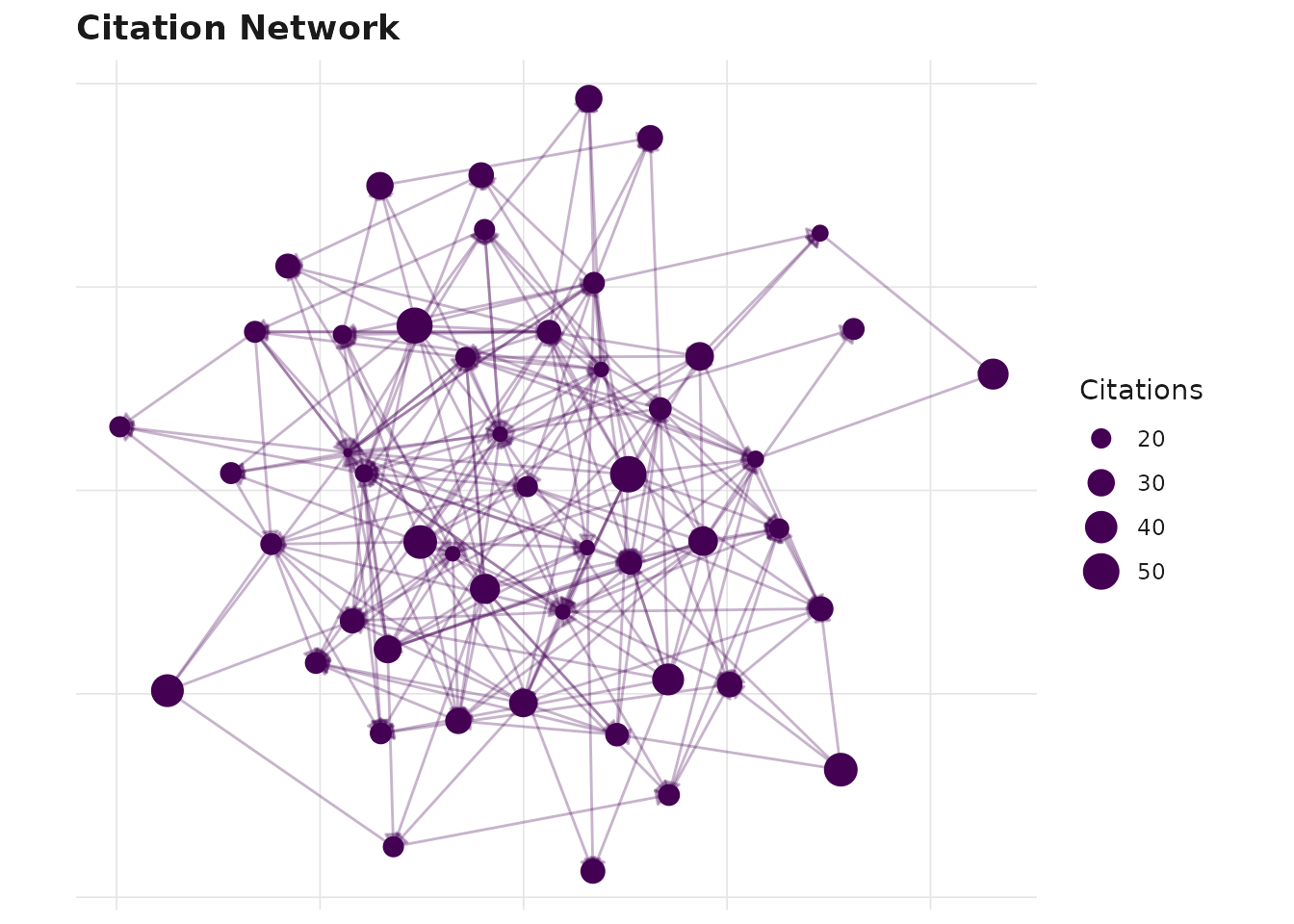
Filtering
recent <- sm_filter_works(corpus, year_range = c(2020, 2024))
nrow(recent$works)
#> [1] 53
Next steps
- See
vignette("ingestion")for building corpora from real data - See
vignette("relationship-to-bibliometrix")for interop with bibliometrix - See
vignette("embeddings-and-clusters")for semantic analysis - Run
sm_run_app()for the interactive Shiny explorer
Use of LLM tools
Portions of this package were prepared with assistance from large
language model tooling for narrowly defined, non-authorial tasks:
copyediting, prose smoothing, Markdown/LaTeX formatting, scaffolding of
boilerplate files (CI configs, build scripts), code refactoring. The
tools used were Chat AI,
the LLM service of KISSKI (GWDG), and a self-hosted Mistral
Small (24B, Apache-2.0) run locally via Ollama and the ollamar R
package — local inference only, with no data sent to third parties for
the self-hosted model.
All scientific claims, methodological choices, analyses, interpretations, and conclusions are the author’s own. No LLM-generated text was incorporated without review and revision, and every reference was verified against its DOI, arXiv ID, or ISBN.