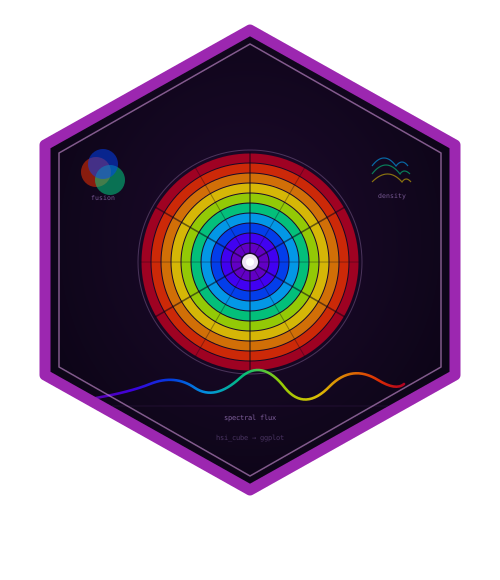
hyperspectaculR 0.2.0 (development candidate)
- Validate real numeric cubes, optional spatial masks and strictly increasing physical wavelengths; keep absent wavelengths as band indices.
- Preserve invalid image pixels as transparent. Correct default fusion thirds and expose explicit available-contributor fusion with recorded counts.
- Fix raw display domains, zero/constant dark endpoints and collapsed percentile fallbacks. Retain raw values and complete enhancement records.
- Expose
hsa_provenance()for compact original-rendering records, including selections, exclusions, endpoints and fallbacks; inspect patchwork components. - Make density histograms exact with irregular-coordinate rectangles, retained population accounting, missing-band overlay gaps and global raw references.
- Add wavelength-span flux normalization and wavelength-target mandala sampling. Preserve legacy argument order and
normalise; reject contradictory options. - Add experimental nonnegative RMS spectral slope and equal-band type-7 quartiles, with explicit units, shared quartile geometry and sampling limits.
- Bound large selection labels while retaining full provenance; avoid redundant band-buffer copies and use a conservative ordinary-range flux path with the full exponent-based calculation retained for extreme arithmetic.
- Replace recording-dependent public figures with a deterministic synthetic gallery, regenerate help and add rendering/minimum-compatibility checks.
- Require ggplot2 >= 3.4.0; retain R >= 4.1.0. Invalid metadata, counts, probabilities, indices, groups and out-of-domain raw values now error.
hyperspectaculR 0.1.0
First release. Publication-grade artistic visualisation of hyperspectral imagery, built on the hsi_cube class from hyperspectR.
Compositions
Each requires the spectral axis: none could be produced from a single wavelength, which is the rule the package holds itself to.
-
hsa_spectral_density()draws the joint distribution of reflectance against wavelength across every pixel, with the mean spectrum and a 5–95% envelope read back off the same binned matrix. The only non-image composition, and the one the others should be read against — every image applies a contrast stretch, and this shows the distribution that stretch is applied to.show_limits = TRUEdraws those limits onto it. -
hsa_mandala()renders concentric annuli, each drawn from a different wavelength, sweeping the spectrum outward from a chosen centre. -
hsa_spectral_flux()sums the absolute change between consecutive bands, giving a field of spectral variability that responds to shape rather than spread — unlike a variance map, it is sensitive to band order. -
hsa_fusion()builds a colour composite from three averaged band groups, which suppresses per-band sensor noise relative to picking three wavelengths.
Design decisions
- Every function returns a
ggplot, so figures compose withpatchwork, re-theme, and export reproducibly. Nothing writes a file as a side effect. - Every rendering captions the contrast stretch and limits it applied. Stretching is what makes this data legible and also what makes it easy to mislead with, so it is never silent.
-
hsa_palette()offers only ramps monotonic in lightness, so ordering survives greyscale printing and stays legible to colourblind readers. Asking forturbowarns that it does not. - Cubes are duck-typed rather than imported, so
hyperspectRstays in Suggests — it is not on CRAN — while the art functions work anywhere a cube can be obtained.
Not included, deliberately
Two visualisations from an earlier draft were dropped rather than ported, both failing the package’s own rule. A 3-D height surface is one scalar per pixel by definition, so its third dimension is a single band or a derived index. A band animation is a sequence of single-band images, so it fails frame by frame. Neither becomes defensible by being rendered more attractively.
Dropping them also removes any need for rayshader, rgl or gifski.