22 Regulating research software and clinical AI
R. Heller · Date: 2026-10-25 · Last changed: 2026-11-09
22.1 Case and decision
The research group behind the fracture alert of Chapter 9 has finished a retrospective evaluation on archived radiographs. The results look good, and the head of the emergency department wants the tool switched on for night shifts from next Monday, “only as a hint”. The hospital’s lead for clinical IT has to sign the go-live. She asks three questions first. What exactly does the tool claim to do, in writing? Who is the manufacturer and who is the user in the legal sense? Which rules apply, and from which date? Nobody can show her a written intended purpose, and the version on the test server has no release record. She postpones the go-live by two weeks and asks the group for a dated classification note. Night shifts continue without the tool. The alternative – a start without a documented basis – would make the hospital responsible for a product nobody has classified.
22.2 Core reading
Four kinds of statement. Every regulatory note in this book separates four kinds of statement, and so should yours. [Law] is the binding text: the EU AI Act (Regulation (EU) 2024/1689, as amended by Regulation (EU) 2026/1744), the Medical Device Regulation (MDR, Regulation (EU) 2017/745) and the In Vitro Diagnostic Medical Device Regulation (IVDR, Regulation (EU) 2017/746) (European Parliament and Council of the European Union 2024b, 2026, 2017a, 2017b). [Guidance] is orientation without legal force, such as MDCG 2019-11 Rev. 1 on software, which states itself that only the Court of Justice can give binding interpretations (Medical Device Coordination Group 2025). [Interpretation] is the professional reading offered in this chapter. [Local] marks a question that only the responsible people in a specific institution can decide, such as the hospital’s regulatory affairs office or legal department. A note that blurs these layers cannot be checked. All statements refer to the legal status of 8 November 2026.
The intended purpose is the hinge. The MDR defines it by what the manufacturer states on the label, in the instructions for use, in promotional material and in the clinical evaluation (Art. 2(12)); the AI Act’s definition adds the specific context and conditions of use (Art. 3(12)) [Law]. MDCG 2019-11 Rev. 1 adds that software needs a medical purpose of its own to qualify as medical device software, and that the stated intended purpose drives qualification and classification (Section 3.1) [Guidance]. The same code can therefore be research software, a medical device or an in vitro diagnostic device, depending on what is claimed for it. The key assumption of this chapter: classification follows the intended purpose as written and communicated, not how cautiously a team plans to use the tool. Table 22.1 contrasts three fictional intended purposes.
| A · Research prototype | B · Clinical decision support | C · IVD context | |
|---|---|---|---|
| Intended purpose (fictional) | Estimates sensitivity and specificity of a fracture model on archived, de-identified radiographs; outputs never reach clinicians | Marks adult wrist and hand radiographs in the emergency department to prompt a second look; every image is still reported by a radiologist | Combines routine laboratory values of inflammatory markers to estimate the risk of fracture-related infection after surgery, for review by the treating team |
| Medical purpose for individual patients? | No [Interpretation] | Yes: computer-aided detection is qualified as medical device software [Guidance, MDCG Annex I b] | Yes, based on data from in vitro diagnostic devices only [Guidance, MDCG Section 3.4, decision steps 1–2] |
| Regulation | MDR not applicable without a medical purpose [Interpretation]; AI Act excludes research before placing on the market (Art. 2(6), 2(8)) [Law] | MDR; classification by Rule 11 (Annex VIII) [Law] | IVDR; software independent of a device is classified in its own right (Annex VIII, rule 1.4) [Law] |
| Case information needed for classification | Proof that no output is used for any patient; who receives results | Seriousness of the clinical situation; whether the output informs, drives or replaces a decision; consequence of a wrong output; users; excluded groups | Which markers; which decision follows (antibiotics, revision surgery); applicable IVDR rule (class B if no other rule applies, Rule 6) [Law] |
| AI Act route | Not in scope while research [Law]; testing in real-world conditions is not excluded (Art. 2(8)) | Class IIa or higher needs a notified body (MDR Art. 52) → high-risk under Art. 6(1) and Annex I [Law] | Classes B–D need a notified body (IVDR Art. 48) → high-risk under Art. 6(1) [Law] |
| Open point | Does a silent pilot in live care count as testing in real-world conditions (Art. 3(57))? [Local] | Is the situation “serious” and the output “informing” (class IIa) or “driving” management (class IIb)? [Interpretation, MDCG Annex III] | Which IVDR rule applies? [Local; MDCG 2020-16 would be the next guidance to read] |
Rule 11 in one paragraph. Software intended to provide information used to take decisions with diagnostic or therapeutic purposes is class IIa, unless such decisions may cause a serious deterioration of health or a surgical intervention (class IIb) or death or an irreversible deterioration (class III); all other software is class I (MDR, Annex VIII, Rule 11) [Law]. MDCG 2019-11 Rev. 1 offers a table that combines the state of the healthcare situation (critical, serious, non-serious) with the significance of the information (treat or diagnose, drive clinical management, inform clinical management); in a serious situation, “inform” maps to class IIa and “treat or diagnose” to class IIb (Annex III) [Guidance]. For vignette B the decisive facts are therefore clinical: what happens to a patient whose fracture is missed, and does anyone act on the marker alone?
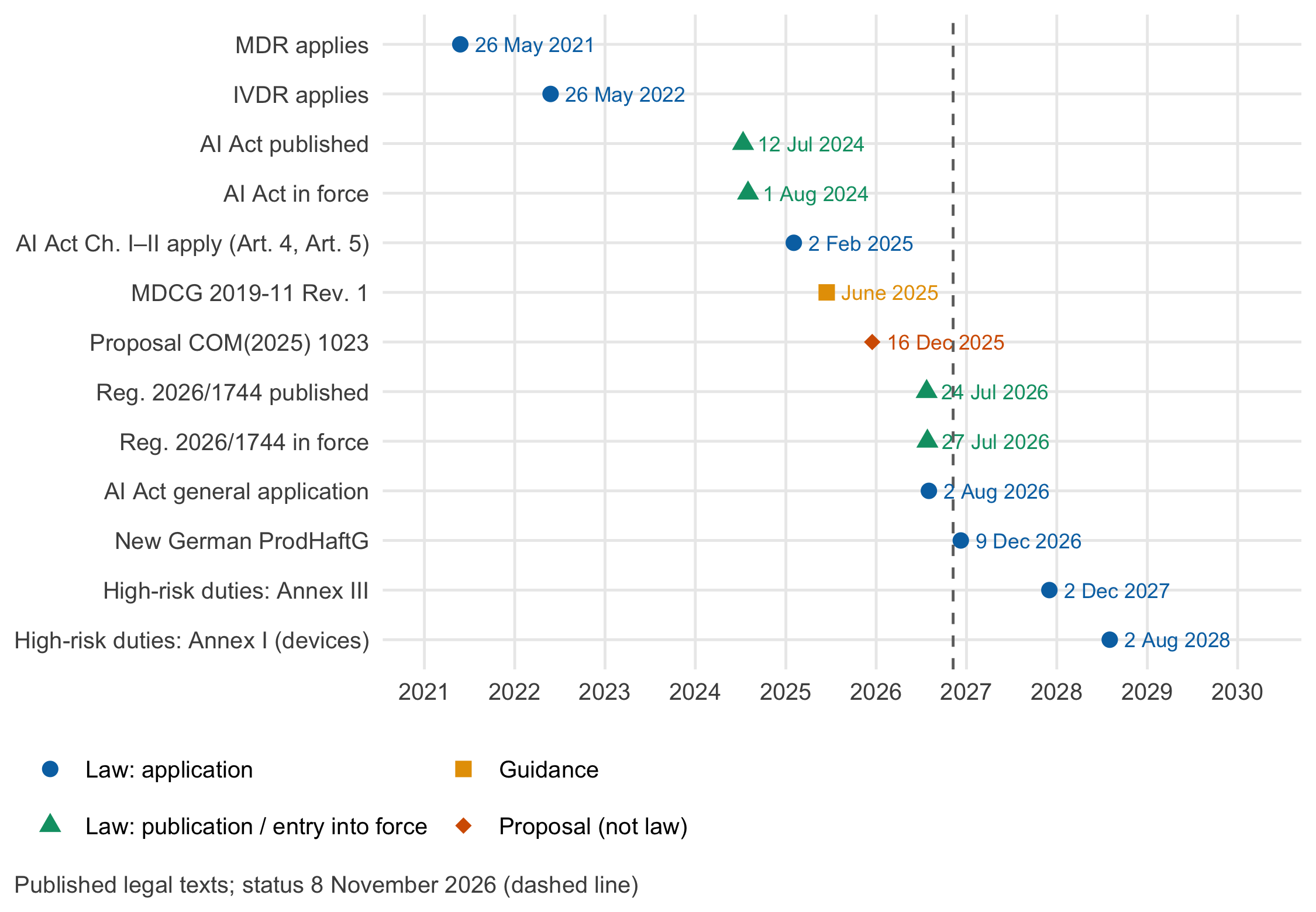
From device class to AI Act. An AI system is high-risk under Art. 6(1) if it is, or is a safety component of, a product covered by the legislation in Annex I and that product must undergo a third-party conformity assessment [Law]. MDR and IVDR are listed in Annex I, Section A (points 11 and 12) [Law]. Class I medical device software is normally self-declared (MDR Art. 52(7)), so it does not meet the second condition; class IIa and higher does. For high-risk systems under Art. 6(1), the requirements of Chapter III, Sections 1–3, apply from 2 August 2028; for Annex III systems from 2 December 2027 (Art. 113, as amended by Regulation (EU) 2026/1744) [Law]. Some duties apply to every AI system already: providers and deployers must take measures to support the AI literacy of their staff (Art. 4, replaced by the 2026 amendment) [Law]. Figure 22.1 places these dates on one axis.
Roles follow actions, not job titles. The AI Act’s provider places a system on the market or puts it into service under its own name (Art. 3(3)); the deployer uses it under its authority (Art. 3(4)) [Law]. The MDR’s corresponding role is the manufacturer. A hospital that develops a tool and uses it only on its own patients may rely on the in-house exemption only if every condition of MDR Art. 5(5) is met, including a documented justification that no equivalent device on the market meets the patients’ needs [Law]. A deployer that changes the intended purpose so that a system becomes high-risk, or modifies it substantially, becomes a provider (AI Act Art. 25(1)) [Law]. Who installed the unreleased version on the test server is therefore not a technical detail.
An open legal question. On 16 December 2025 the European Commission proposed to amend MDR and IVDR and to move both from Section A to Section B of Annex I of the AI Act (European Commission 2025). Under the amended Art. 2(2), only a few AI Act provisions would then apply directly to such devices [Law, as amended in 2026]. On 8 November 2026 the proposal was awaiting a committee decision in the European Parliament; it is not law [Local check of the procedure file needed before every edition]. A plan that relies on the proposal passing would be a bet.
Question for the workshop: Rewrite the intended purpose of vignette B so that it stays class IIa under the MDCG table, and name one sentence in the hospital’s internal guidance that would quietly turn it into something else.
22.3 Decision exercise
Source reading (30 minutes). Read, in the English versions on EUR-Lex: MDR Art. 2(1) and 2(12), Art. 5(5), Art. 52(7) and Annex VIII Rule 11; IVDR Art. 2(2) and Annex VIII rules 1.4 and 6; the AI Act Art. 2(6), 2(8), 3(3), 3(4), 3(12), 6(1), 14(4), 25(1) and 26, together with the amending Regulation (EU) 2026/1744, points (5) and (40) of Article 1; and MDCG 2019-11 Rev. 1, Sections 3.1, 3.4, 4.2.1 and Annex III.
Role task. Work in four roles: the research group (potential manufacturer and provider), clinical IT of the hospital (deployer), regulatory affairs, and the emergency physician who would use the alert. Each role writes down the one fact it needs from another role before it can agree to go-live. Then write two dated classification notes. The first is worked out below as the expected result; the second is yours.
NoteClassification note 1 · vignette B · dated 8 November 2026 (expected result)
- Legal status checked: AI Act as amended by Regulation (EU) 2026/1744 (in force since 27 July 2026); MDR and IVDR consolidated texts on EUR-Lex; MDCG 2019-11 Rev. 1 (June 2025). Checked by: regulatory affairs (role).
- Intended purpose (quoted from the draft instructions for use): “Marks adult wrist and hand radiographs in the emergency department to prompt a second look; every image is still reported by a radiologist.”
- Qualification: medical device software [Guidance: MDCG 2019-11 Rev. 1, Annex I b, computer-aided detection].
- Classification: Rule 11(a); at least class IIa [Law]. Class IIa assumes a serious situation and information that informs clinical management [Guidance: MDCG Annex III]. Class IIb would follow if the output drove or replaced the diagnostic decision [Interpretation].
- AI Act: high-risk under Art. 6(1) because a notified body is involved; Chapter III duties from 2 August 2028 [Law]. Art. 4 (AI literacy) applies now [Law].
- Roles: research group’s university as manufacturer and provider if it supplies the tool; hospital as deployer. In-house use under MDR Art. 5(5) only if every condition is documented [Law; Local].
- Missing documents: written instructions for use; clinical evaluation plan; release record for the installed version; justification under Art. 5(5)(c) if in-house use is intended.
- Decision: no clinical go-live; silent evaluation continues as research after local review of whether it counts as testing in real-world conditions [Local]. Next review: when the missing documents are available.
Your note. Write note 2 for vignette C, or for vignette B after the emergency department adds this line to its night-shift guidance: “Radiographs without a marker are not reviewed by the on-call senior before the morning report.”
TipAnswer
Vignette B with the night-shift line. The guidance changes how the output is used: the absence of a marker now decides who gets a senior review. The software no longer only informs clinical management; in practice it drives it. Under the MDCG table this points towards class IIb in a serious situation [Guidance]. More important, the hospital has changed the use by its own instruction, so the device is now used outside its intended purpose [Interpretation]. Whether such a change of use, without any change to the software, would make the hospital a provider under AI Act Art. 25(1) once the high-risk duties apply is not settled by the text, because a “substantial modification” is defined as a change to the AI system (Art. 3(23)) [Interpretation; Local]. The note should say: “The guidance line is withdrawn; any change of use requires a new note.”
Vignette C. Qualification as IVD medical device software [Guidance: MDCG Section 3.4]. The IVDR class is open until the rule is determined [Local]; independent software is classified in its own right, and Rule 6 gives class B where no other rule applies [Law]. Any class from B upwards involves a notified body, so the system would be high-risk under AI Act Art. 6(1) from 2 August 2028 [Law]. If the hospital laboratory develops it in-house, Art. 5(5) IVDR requires, among other things, compliance with EN ISO 15189 or applicable national provisions [Law].
Alternative. Instead of in-house development, the hospital procures a CE-marked product whose intended purpose matches vignette B. This shifts the manufacturer’s duties to the supplier but leaves the deployer’s duties with the hospital, including human oversight and monitoring (Chapter 20).
Residual question. Who in the hospital is entitled to change the night-shift guidance, and how does that person learn that a guidance line can change the legal status of a device?
22.4 Counter-check
Change one word of the intended purpose and predict the effect before you look it up. Predict: what happens to the classification of vignette B if “prompt a second look” becomes “identify radiographs that need no radiologist report”? And what happens if the outputs are only stored in a research database and never shown?
In the first case the significance of the information rises from “inform” to “diagnose”, because the tool now decides which images are read by a specialist. In a serious situation the MDCG table points to class IIb [Guidance]. A further question opens: the AI Act lists “emergency healthcare patient triage systems” in Annex III, point 5(d) [Law]. Whether an image worklist filter is a patient triage system is not settled by the text [Interpretation; Local]. In the second case the medical purpose for individual patients disappears. The MDR does not apply, and the AI Act does not apply to research before placing on the market (Art. 2(8)) [Law]. Data protection law still applies in full (Chapter 23). The same algorithm moves between three regulatory worlds without a single change of code.
22.5 Consequences for patients and operations
An open legal question changes the plan. The pending Commission proposal, the open IVDR rule for vignette C and the unclear status of a silent pilot do not prevent work. They change what work is done and in which order. Table 22.2 shows the deployment plan before and after the classification note.
| Element | Plan before the note | Plan after the note |
|---|---|---|
| Start | Night shifts from next Monday | No clinical use; silent evaluation as research after local review |
| Intended purpose | Oral (“only a hint”) | Written, quoted in every note; changes only via a new note |
| Version | Whatever is on the test server | Released version with a record; installed version checked against it (Chapter 24) |
| Role | Unclear | Manufacturer, provider and deployer named; in-house route only with Art. 5(5) documentation |
| AI Act | Ignored until 2028 | Art. 4 measures now; high-risk duties planned for 2 August 2028 under current law, reviewed if the proposal is adopted |
| Training | None | AI literacy session for night-shift staff (Art. 4) before any clinical use |
For patients, the decisive point is that the alert is used only for what it was evaluated for. A tool tested as a second-look prompt in adults has no evidence for children or for deciding who need not be reviewed (Chapter 21).
Liability. Germany’s new Product Liability Act (Produkthaftungsgesetz, ProdHaftG) treats software as a product (§ 2(1) no. 3) and enters into force on 9 December 2026; products placed on the market or put into service up to and including 8 December 2026 remain under the previous act (§ 23) [Federal Republic of Germany (2026); Law]. It implements Directive (EU) 2024/2853 (European Parliament and Council of the European Union 2024a). Who is liable for a self-developed tool is a question for the hospital’s legal department [Local].
NoteThe incident from the regulatory perspective
A report excerpt appears in a service provider’s support log, and the installed model version differs from the approved one. The regulatory questions are: which intended purpose, product version and role are documented, and is this a possible product or vigilance matter? If the tool is a CE-marked device, the manufacturer reports serious incidents under MDR Art. 87 [Law]; in Germany, anyone who operates or uses a medical device professionally must report suspected serious incidents to the competent federal authority without undue delay (Medical Devices User Reporting and Information Ordinance (Medizinprodukte-Anwendermelde- und Informationsverordnung, MPAMIV), § 3) [Federal Republic of Germany (2021); Law]. Whether a wrong version or a data leak is a “serious incident” depends on its effect on patients [Interpretation; Local]. A good answer keeps facts, legal source and missing information apart and routes the question to the person responsible for medical device safety in the hospital. Under the AI Act, deployers of high-risk systems must suspend use and inform the provider when they have reason to consider that the system presents a risk (Art. 26(5)); for devices this applies from 2 August 2028 [Law].
22.6 Look up and transfer
Reviewer question. Does the manuscript state the intended purpose in the words of the instructions for use, and does the claimed benefit stay within it? A study that evaluates a “second look” but concludes that the tool can “replace” a reading has changed the intended purpose in the discussion section.
Self-test. A physiotherapy team develops a smartphone app that measures knee flexion from video (Chapter 11) and, based on the angle, recommends to patients at home after knee surgery whether to progress their exercises. The team calls it “a research app”. Which facts do you need to classify it, and what is your first assessment?
TipAnswer
The label “research app” is irrelevant if patients use the recommendations for their own treatment. MDCG 2019-11 Rev. 1 lists as medical device software an application that uses data of a patient with a musculoskeletal pathology to recommend personalised rehabilitation exercises (Section 3.2) [Guidance]. The app provides information used for therapeutic decisions, so Rule 11(a) gives at least class IIa [Law]; class IIb would apply if a wrong recommendation could cause a serious deterioration of health or surgery [Law; Interpretation]. Facts needed: the written intended purpose, users (laypersons), the population, the decisions that follow, the consequences of a wrong angle, and whether a clinician reviews the recommendation. With class IIa or higher, a notified body is involved, so the AI component would be high-risk under AI Act Art. 6(1) from 2 August 2028 [Law]. Until then the team needs a clinical investigation plan if it wants to test the app on patients, and a data-protection review for the videos (Chapter 23).
Annotated sources.
- European Parliament and Council of the European Union (2024b) and European Parliament and Council of the European Union (2026) – the AI Act and its 2026 amendment; used for definitions, the high-risk route, human oversight, deployer duties and the new application dates.
- European Parliament and Council of the European Union (2017a) and European Parliament and Council of the European Union (2017b) – definitions, in-house exemption, Rule 11 and the IVDR classification rules.
- Medical Device Coordination Group (2025) – guidance on qualification and classification of software, including the IMDRF-based table; not binding.
- European Commission (2025) – the pending proposal that would move MDR and IVDR to Annex I Section B of the AI Act.
- Federal Republic of Germany (2021) – the German user reporting duty for suspected serious incidents.
- Federal Republic of Germany (2026) and European Parliament and Council of the European Union (2024a) – the new liability regime that treats software as a product.
22.7 Further reading
- Chapter 20 – how a pilot is monitored and stopped; the deployer’s duties in practice.
- Chapter 23 – the data-protection review that runs in parallel to the regulatory note.
- Chapter 24 – release records and version checks that make a “documented version” verifiable.
- Chapter 27 – the model passport and decision sheet into which the classification note is copied.
- Methods in R: Reporting templates and TRIPOD-AI – how the evidence behind an intended purpose is reported.
- Methods in R: Writing a report – structure and reproducibility of the report that a notified body or ethics committee will read.
- CTTIR Courses: Research workflow – where the regulatory note fits between question, design and validation.
- CTTIR Courses: Writing a report – a compact guide to writing up methods and limitations.